How to Decorate Bedroom Walls in 9 Steps, With the Sizes and Heights That Work
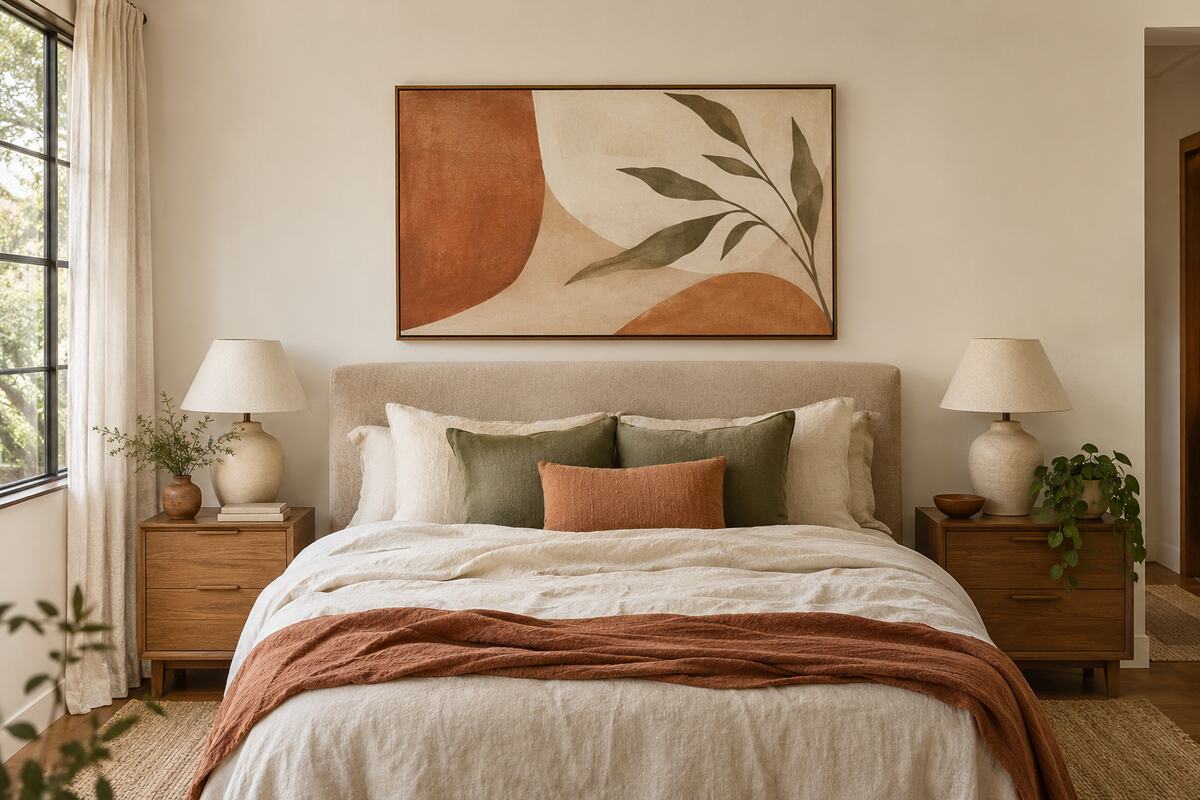
This guide shows you how to decorate bedroom walls in the order that saves you extra nail holes: pick the wall, size the art to the bed, mark the height, then hang it with hardware that is safe above where you sleep. The sizes and heights come from the hanging guides of frame makers and retailers, so you are not eyeballing it.
It works for one big print, a gallery wall, a picture ledge or a soft wall hanging. Mirrors and wallpaper have their own guides, linked where they fit.
THE NUMBERS AT A GLANCE
Width
Two-thirds to three-quarters of the bed's width.
Gap above headboard
7 to 10 inches, per Framebridge.
Open wall
Center of the art about 57 inches up.
Gallery gaps
2 to 3 inches, kept even.
What you need:
- A tape measure, a pencil and a level
- Painter’s tape and kraft paper (or old wrapping paper) for templates
- A bathroom scale to weigh each piece
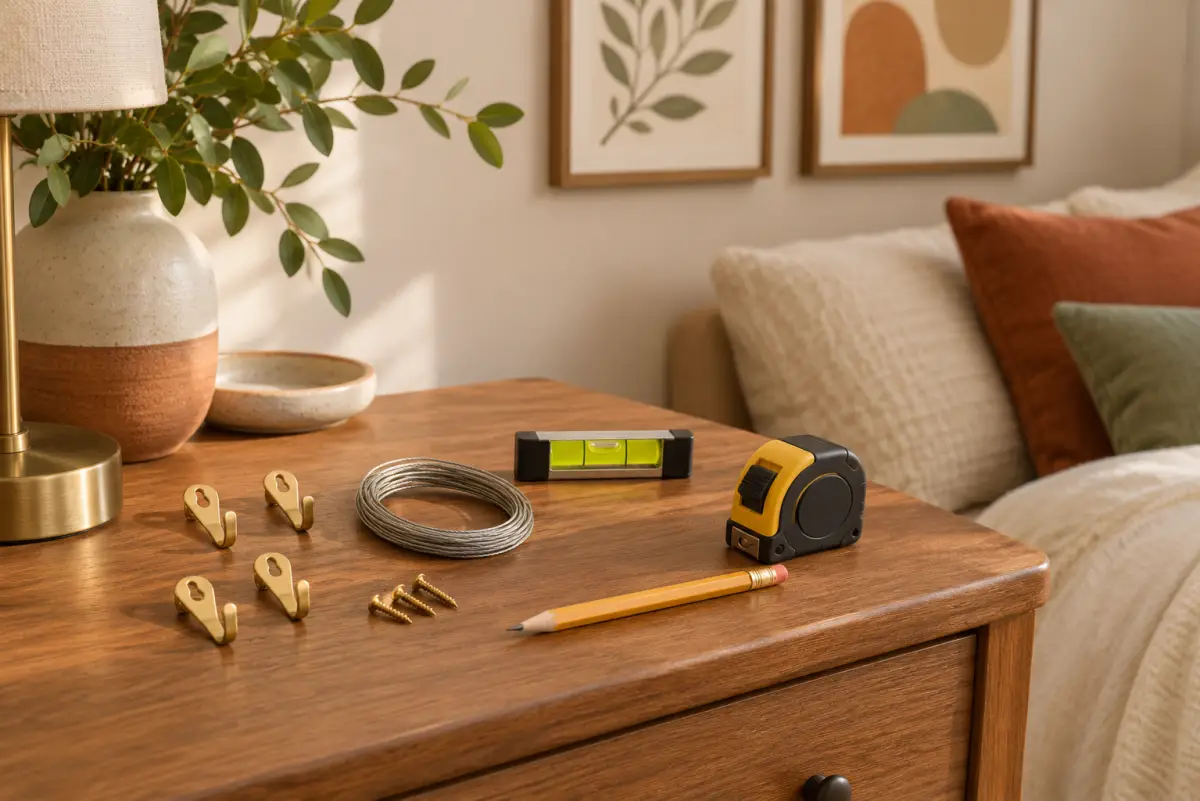
- Picture hangers, screws or drywall hangers rated for the weight
- A stud finder and a drill if anything is heavy or goes on a shelf
- Your art, frames, ledge or wall hanging
1. Choose one focal wall
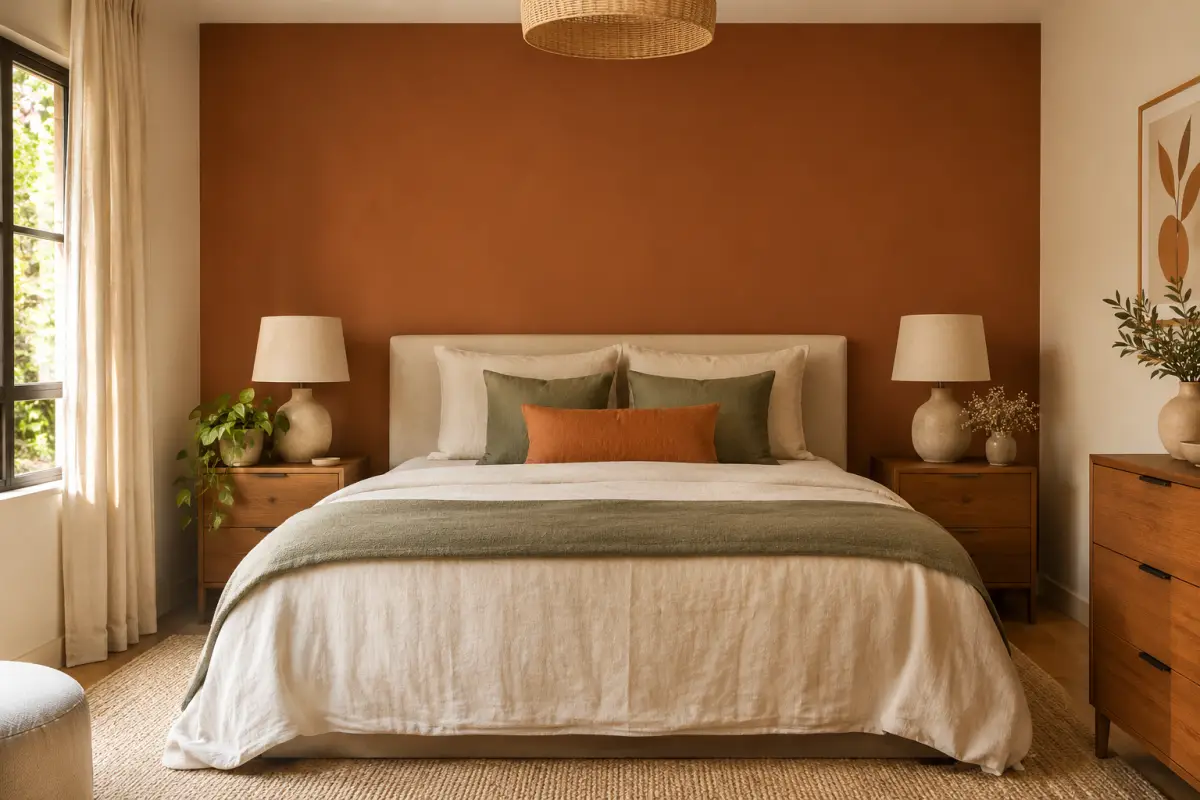
Start with the wall you see first from the door, which in most bedrooms is the wall behind the bed. That wall gets your biggest piece or your most planned arrangement, and the other walls stay quieter. A bedroom with art on every wall at the same volume feels busy when you are trying to rest.
If your bed is oversized and fills that wall, Minted’s bedroom wall art tips suggest hanging the art on the wall opposite the bed instead, and using an oversized print as the headboard if you have no bed frame.
Want color behind the art? Do it first. Our guides to painting a bedroom and peel-and-stick bedroom wallpaper cover that part.
2. Measure the bed, then size the art to it
Measure the full width of the bed, frame included, and the space between the top of the headboard and the ceiling. The bed sets the size of the art, not the wall.
Framebridge’s gallery wall placement guide says a group above the bed should be about two-thirds the width of the bed. Minted’s art size guide gives two-thirds to three-quarters of the furniture width, which works out to a piece 40 to 45 inches wide above a queen and 54 to 60 inches above a king.
A pair of prints or a whole gallery wall counts as one piece here: measure from the outer edge of the first frame to the outer edge of the last.
How wide should art above the bed be?
Queen bed
40 to 45 inches wide
King bed
54 to 60 inches wide
Any other bed
Bed width x two-thirds, up to three-quarters
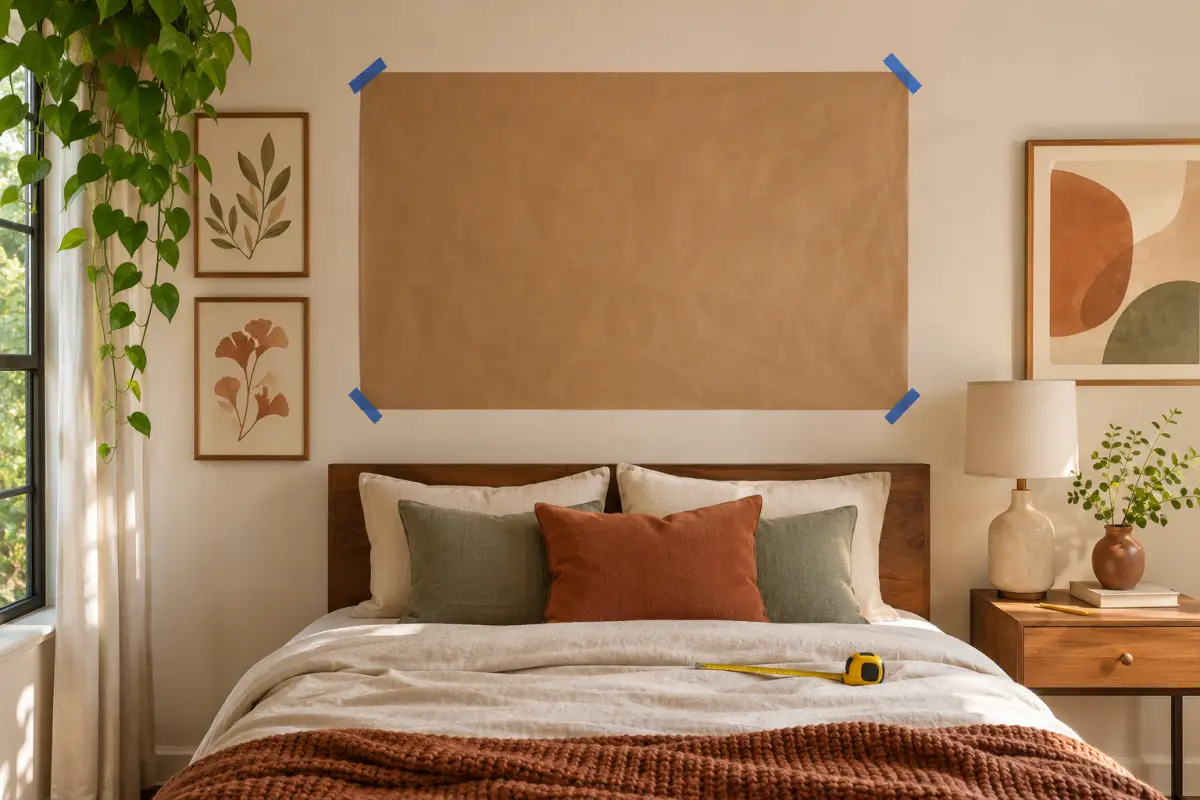
Before you buy, cut kraft paper to the size you are considering and tape it above the bed. Minted recommends paper templates or painter’s tape to check spacing before hanging, and it is the quickest way to see if a piece is too small.
3. Mark the height before you hammer
Above a bed, measure up from the top of the headboard, not the floor. Framebridge suggests the bottom of the frame sits 7 to 10 inches above the top of the furniture, and names the bed as one of those pieces. Minted’s range is a little wider, about 3 to 10 inches between the top of the furniture and the frame.
With a tall headboard, stay at the low end of that range so the art does not drift up toward the ceiling. With a low headboard or none, the higher end keeps it from feeling squashed.
On a wall with no furniture under it, Framebridge suggests the vertical center of the art at about 57 inches above the floor. To mark it, measure the height of the piece, divide it in half and add that to 57 inches: that mark is where the top of the frame goes.
Where to mark the wall
Above the bed
Bottom of frame 7 to 10 inches over the headboard
Wider range
3 to 10 inches over the furniture
Open wall
Center of the art about 57 inches from the floor
One more measurement saves a second hole: on the back of the frame, pull the wire tight toward the top (or find the sawtooth hanger) and measure from there to the top edge. Your nail goes that far below your top-of-frame mark.

4. Pick hardware rated for the weight
Weigh each piece before you choose a hanger: step on a bathroom scale holding it, then without it. Every hanger and anchor package lists a weight rating, and a frame should sit well under it.
For heavy frames on drywall, 3M says its CLAW drywall picture hangers hold mirrors, frames and large wall art up to 65 lbs. Screws driven into a stud are the other strong choice, and they are what a shelf or ledge needs.
Skip adhesive strips for this spot. The Command picture hanging strip instructions say plainly: “DO NOT hang over beds or on wallpaper”. They also say to wait 7 days after painting before using the strips, so plan strips for the side walls after the paint has had time.
5. Keep the wall above the bed light and secure
The wall over your pillows is the one place where a falling frame lands on someone. The County of San Mateo’s home emergency guide tells residents to move mirrors and heavy pictures away from places where people sit or sleep, and to secure pictures and wall hangings. It is emergency-preparedness advice, and it makes sense in any bedroom.
In practice: choose lighter frames for this spot, pick an acrylic front over glass when you can, and hang each frame on two hangers so it cannot swing off a single nail. Save the heavy mirror for another wall, as our bedroom mirror ideas explain in detail.
If you rent, ask before drilling into studs, and use hardware your lease allows.

6. Lay out a gallery wall on the floor first
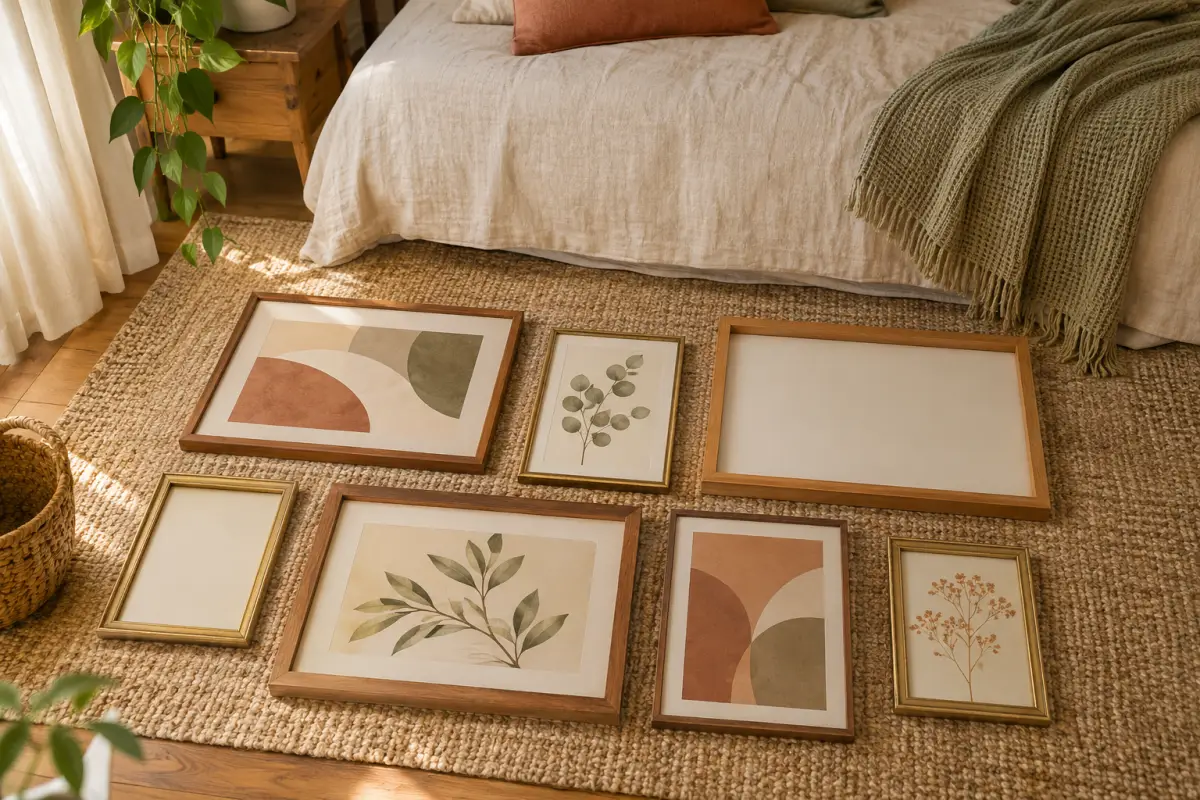
Lay every frame on the floor or a big table and move them around until the group feels right, as Framebridge suggests. Keep the gaps between frames at 2 to 3 inches and the same all the way through, and avoid spots where four frame corners meet.
Then trace each frame on kraft paper, mark where its nail goes on the paper, and tape the sheets to the wall. Minted puts the gap at about 3 inches and also recommends paper templates or painter’s tape for checking spacing. When the paper layout looks right, nail through the marks and tear the paper away.
Hang the lowest piece first, then work out to the sides and up. The whole group follows the width rule from the measuring step and sits about seven to ten inches above the headboard.
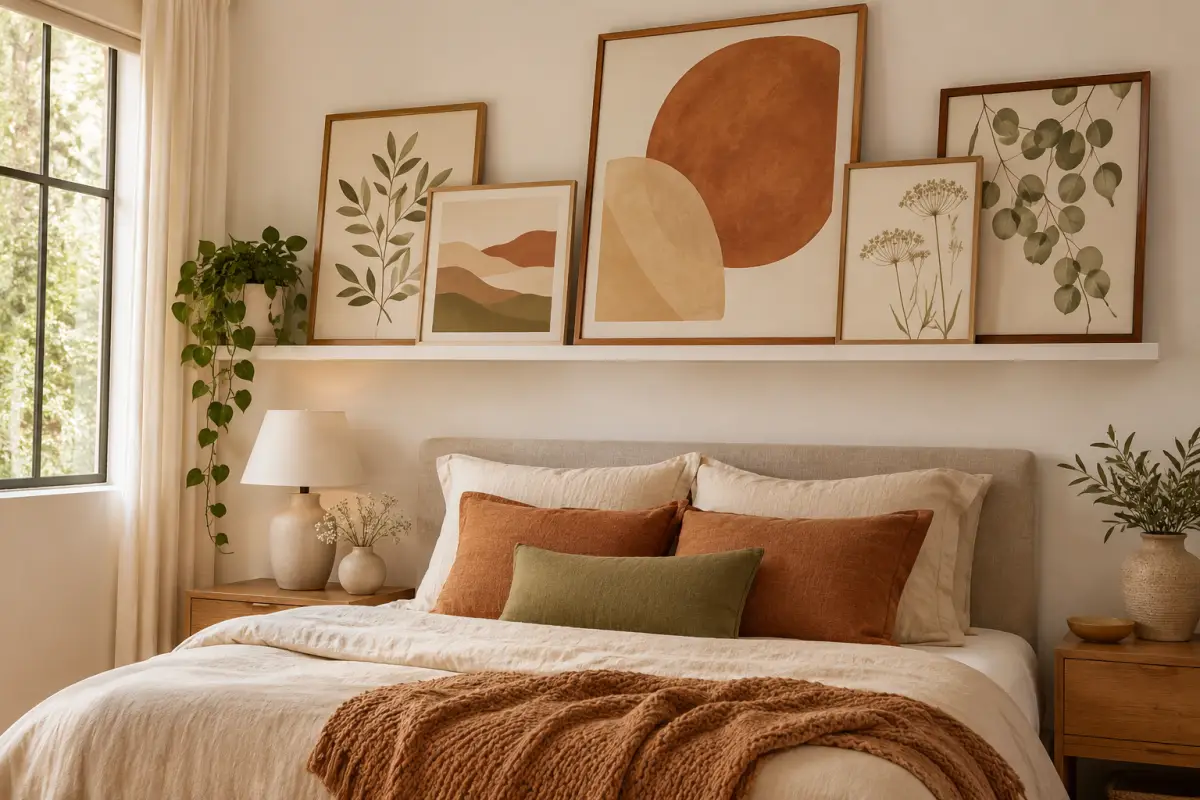
7. Add a picture ledge for art you can swap
A picture ledge lets you change art without new holes, which suits renters and people who cannot decide. IKEA’s MOSSLANDA ledge, for example, is 45 1/4 inches long with a maximum load of 16.53 lb, and it comes without the screws and wall anchors needed to mount it.
To style it, Pottery Barn’s art hanging guide suggests starting with one focal piece placed slightly off-center, then layering additional pieces of various sizes around it. Lean a large print at the back and a smaller one in front so they overlap a little.
Over a bed, keep the ledge to frames only. Vases, candles and books belong on a shelf above a dresser, where nothing can tip onto you.
8. Soften the wall with textiles
A woven wall hanging, a vintage quilt or a fabric panel adds texture that flat art cannot, and it is the lightest choice for the wall above a bed. There is no glass to break and little weight to hold.
Hang it from a wooden dowel or a slim curtain rod resting on two screws or hooks, so the weight spreads across the width. A textile about as wide as the art rule for the bed looks planned rather than small.
Fabric also suits the bedroom’s quieter mood. Choose colors already in your bedding so the wall and the bed read as one.

9. Finish the side walls
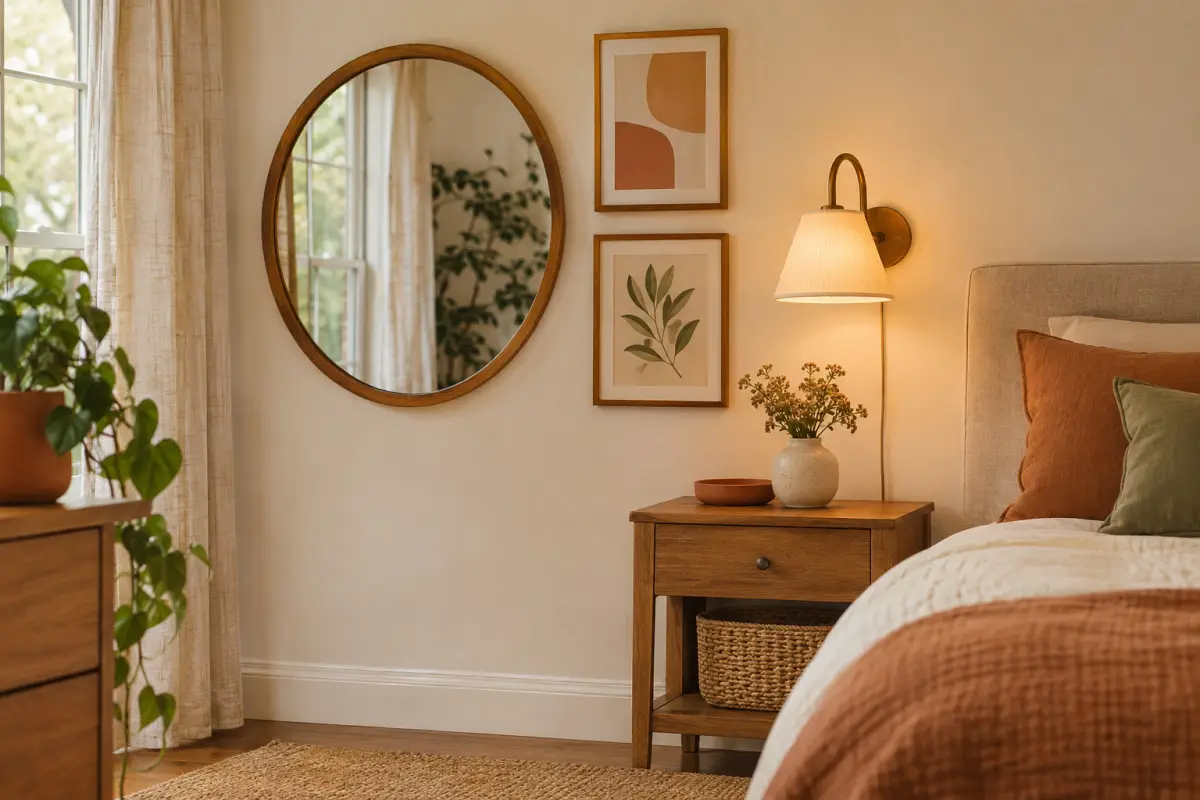
With the focal wall done, the side walls need only a little. A mirror opposite the window brings in daylight, a pair of plug-in sconces beside the bed frees up the nightstands, and a narrow column of two or three small frames fills the slim wall next to a nightstand.
Keep these lighter in color and scale than the wall behind the bed. Find sconce placement in our guide to layered bedroom lighting, and more ideas in our bedroom wall decor section.
Common mistakes to avoid
Avoid
- Art far too small for the bed
- Hanging by eye, too close to the ceiling
- Adhesive strips over the bed
- Heavy mirrors or glass over the pillows
- Uneven gaps in a gallery wall
Do instead
- Size art to the bed's width
- Measure up from the headboard
- Use hangers rated for the weight
- Keep light pieces above the bed
- Plan the layout on paper first
The most common one is buying art first and measuring later. Start from the bed width and the shopping gets much easier.
How to decorate bedroom walls: FAQ
What should I put on the wall above my bed?
Something wide and light: one large print, a pair of matching prints, a gallery wall in light frames, a picture ledge with frames, or a woven hanging. Keep heavy mirrors and glass for other walls, since emergency guides advise moving heavy pictures away from where people sleep.
How high should art be above a bed?
Measure from the top of the headboard. Framebridge suggests the bottom of the frame at 7 to 10 inches above it, and Minted gives a range of 3 to 10 inches.
What size art goes above a queen or king bed?
Minted suggests 40 to 45 inches wide above a queen and 54 to 60 inches above a king, which is two-thirds to three-quarters of the bed’s width.
Can I use Command strips above my bed?
No. The maker’s own instructions for Command picture hanging strips say not to hang them over beds or on wallpaper. Use hangers that go into the wall and are rated for the weight.
How do I decorate a plain bedroom wall on a budget?
Frame a few prints in matching frames, lean them on a picture ledge, or hang a textile you already own from a dowel. Our bedroom makeover on a budget guide has more low-cost swaps.
Save this guide to your bedroom board so the measurements are there when you start hanging, and begin with one wall this weekend.
Sources
- How to Choose the Right Art Size for Any Wall, Minted
- What is the “right” height to hang a frame?, Framebridge, 2023-10-05
- How to hang a personalized, one-of-a-kind gallery wall, Framebridge, 2023-10-07
- Choosing Bedroom Wall Art and Above the Bed Decor, Minted
- Where to Hang a Gallery Wall, Framebridge
- How to Hang Heavy Mirrors and Frames, 3M
- How to Use Command™ Strips for Hanging Pictures, 3M (Command™ Brand)
- Emergency - Your Home, County of San Mateo, California
- MOSSLANDA Picture ledge, white, 45 1/4”, IKEA US
- How to Hang Artwork, Pottery Barn