18 Peel and Stick Wallpaper Bedroom Ideas Renters Can Take Down Later
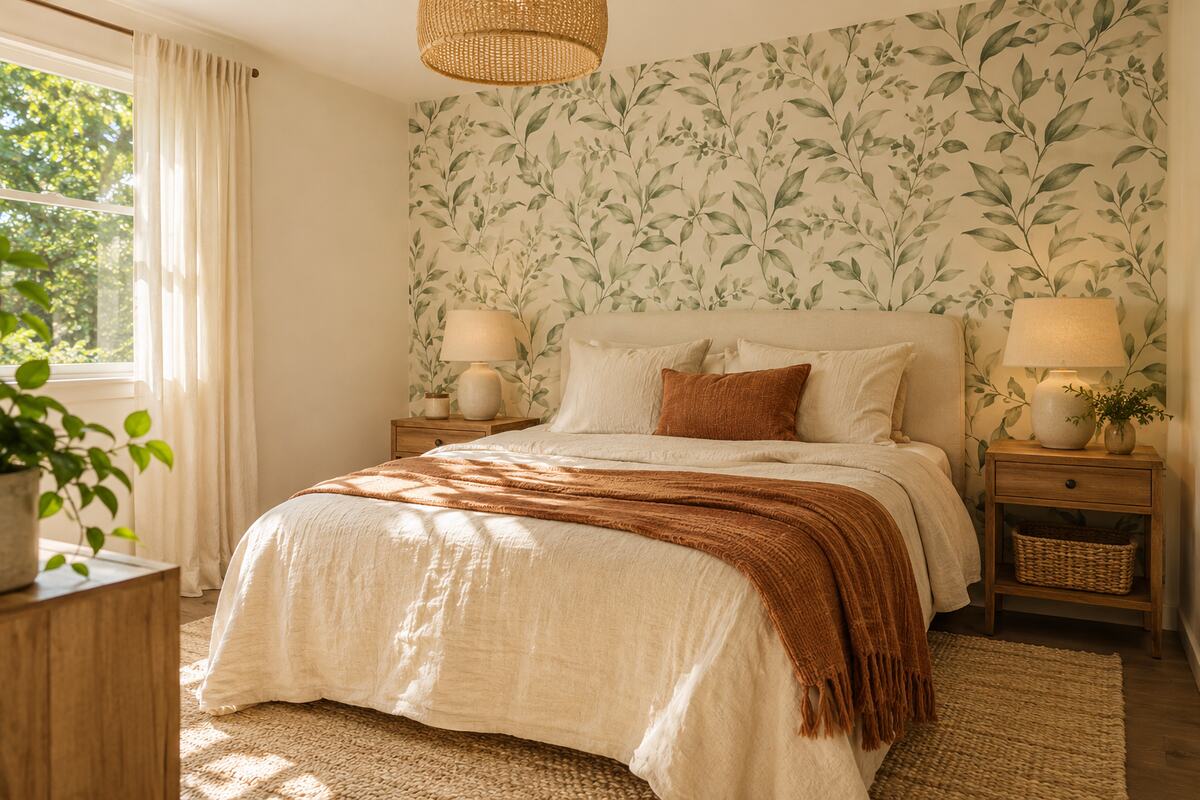
These peel and stick wallpaper bedroom ideas show you where the paper goes, which patterns suit a bedroom and what to buy for each look. After the ideas, you get the checks that decide whether it comes off cleanly later, taken straight from the wallpaper makers’ own instructions.
That last part matters most if you rent. Peel and stick paper is made to come off, but the wall underneath has a say too, so read the “Before you buy” section before you order rolls.
Where to put peel and stick wallpaper in a bedroom
Start with the spot, then pick the pattern. A small area is cheaper, faster to hang and easier to remove when you move out.
1. One accent wall behind the bed
The wall behind the bed is the classic place for bedroom wallpaper because you see it every time you walk in, but not while you are trying to sleep. It also leaves the other three walls plain, so a bold print does not take over the room.
Pick the wall with no windows or doors if you can. Fewer cuts means a faster job and a neater result.
Get the look: one wall of patterned paper, plain walls in a matching light color, bedding pulled from one color in the print.

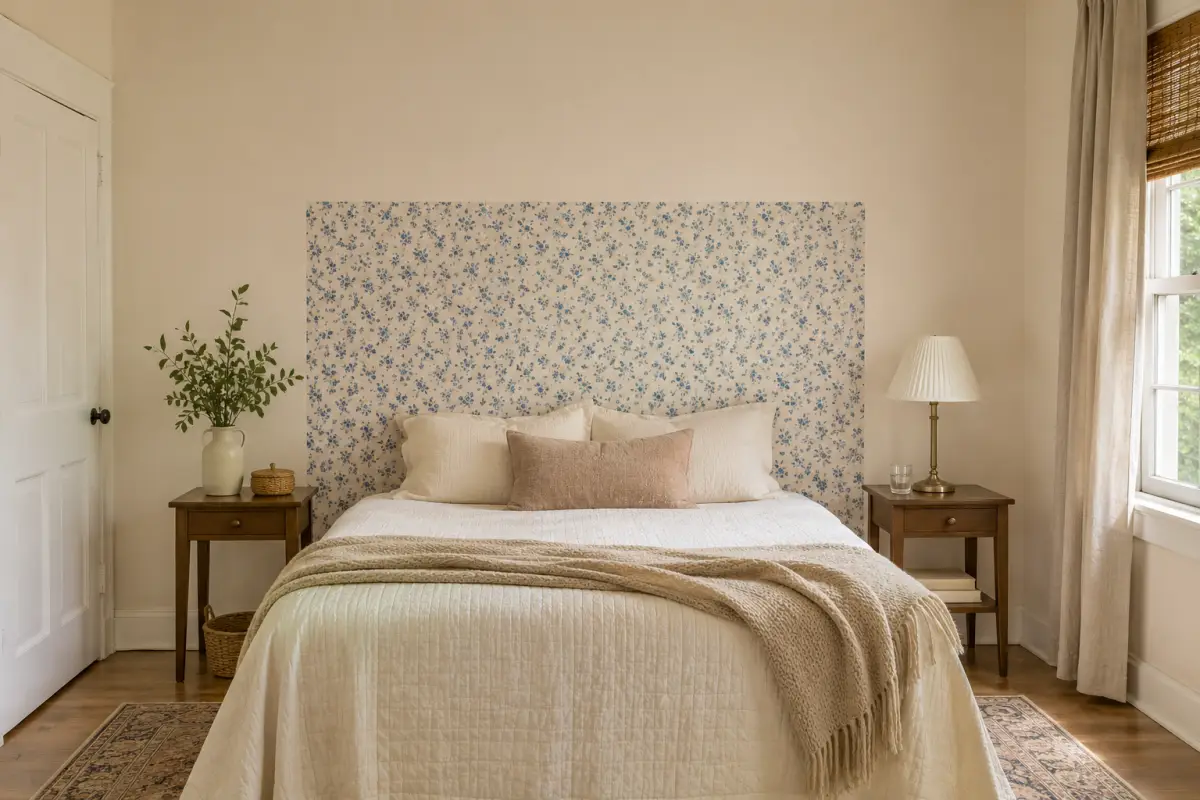
2. A wallpaper “headboard” panel
No headboard? Paper a rectangle of wall a little wider than the bed and run it from the floor to about two-thirds of the way up the wall. It reads as a headboard and costs far less to cover than a full wall.
Draw the outline with a level and a pencil first, then trim the edges with a sharp knife so the top line stays crisp. For more ways to fake or upgrade the bed wall, see our headboard ideas.
Get the look: a bold small-scale print, a level, a pencil, a craft knife and a bed pushed against the panel.
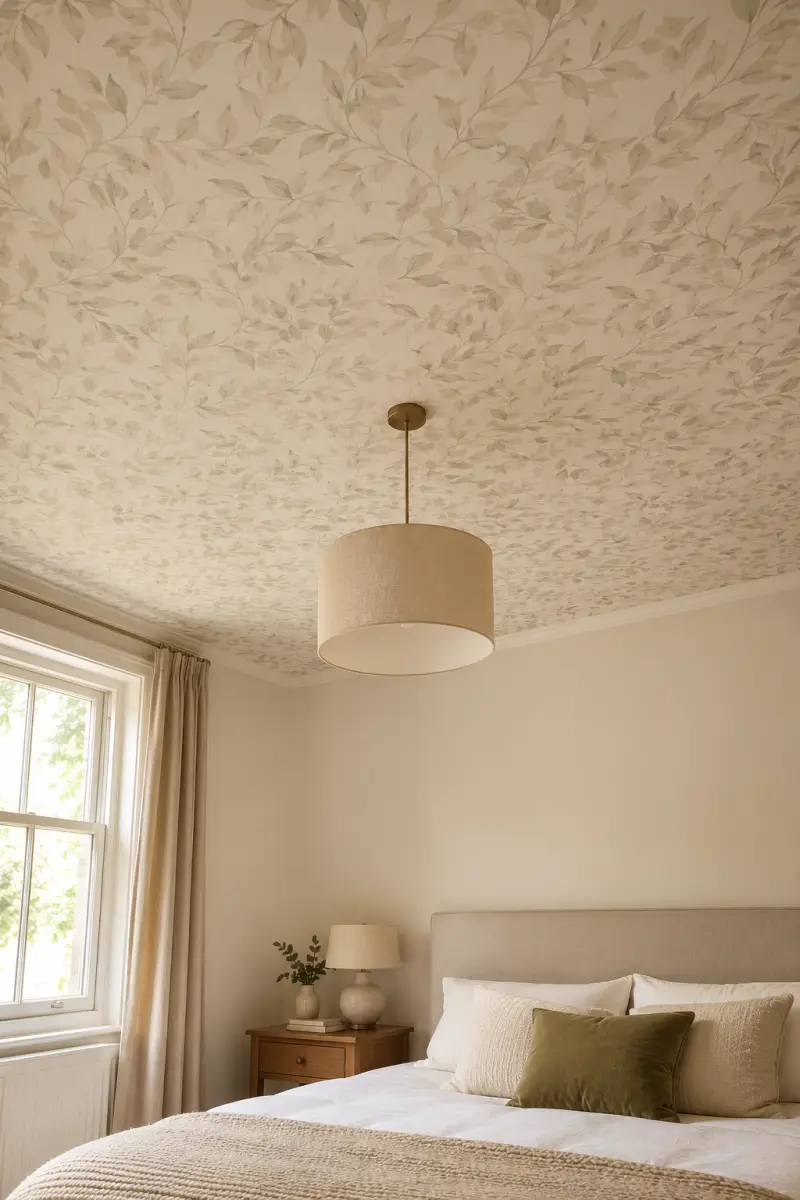
3. The ceiling
A papered ceiling makes a bedroom feel finished from the bed, which is where you look up from most. A soft pattern works better overhead than high contrast.
Tempaper lists ceilings among the places its paper can go, and WallPops says NuWallpaper will adhere to a ceiling that is “smooth, flat, dry, and clean”. Overhead work is tiring, so plan for a helper and a sturdy step stool.
Get the look: a small cloud, star or tonal leaf print, plain walls, a simple pendant light.
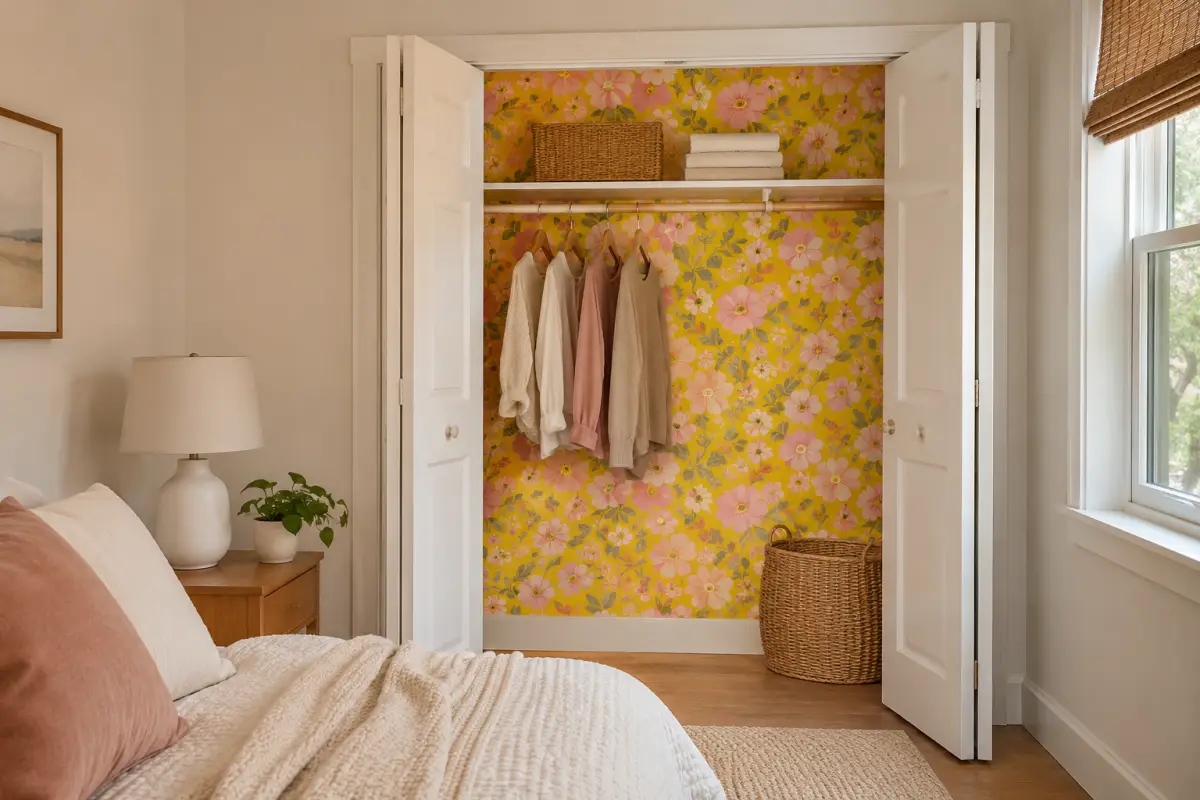
4. Inside the closet
Papering the inside of a closet gives you a hit of pattern every time you open the door, without committing the whole room to it. It is also a small job, which makes it a good first project.
Pick a cheerful print here. Closets are seen in short bursts, so you can go brighter than you would behind the bed.
Get the look: one roll of a bright print, the closet’s back wall only, a light bulb that shows the color well.
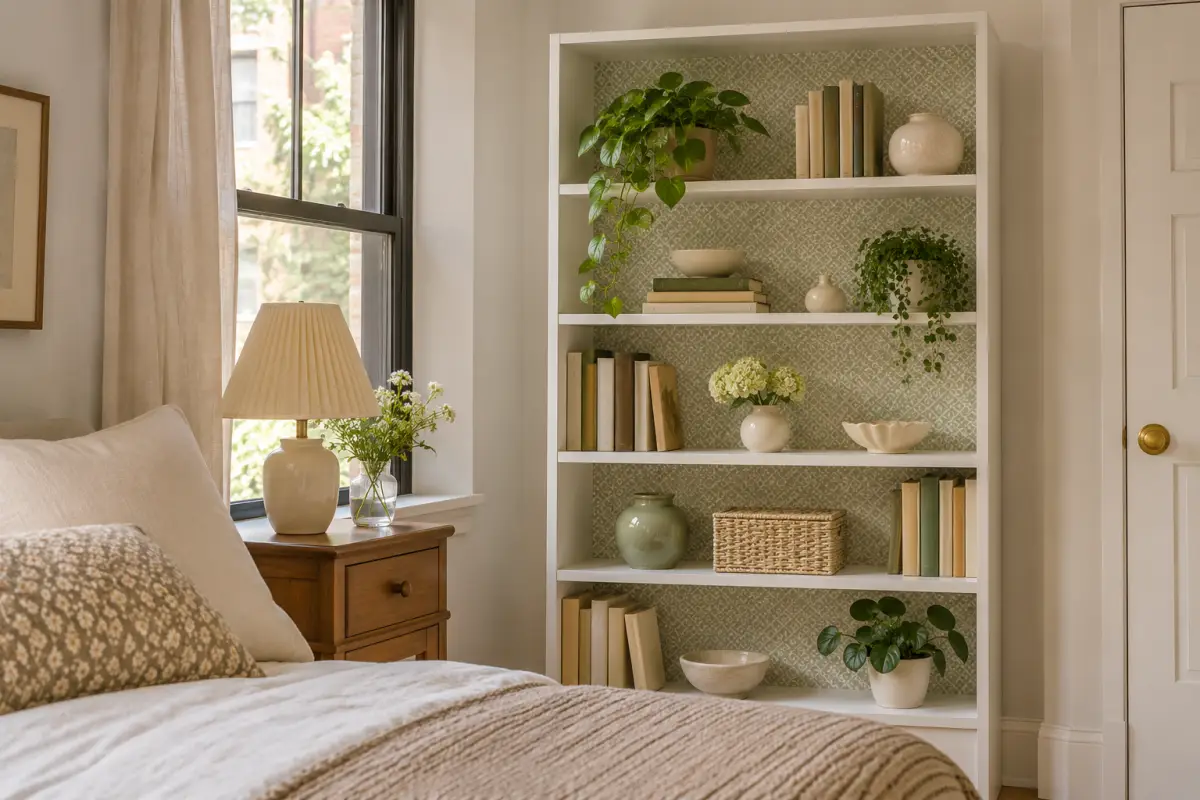
5. The back of an open bookcase
An open bookcase with papered back panels looks custom, and the books in front hide any small trimming mistakes. Tempaper names bookshelves, dressers and drawers among the small projects its paper suits.
Take everything off the shelves and wipe the back panel clean before you start. Cut each piece to fit one shelf opening at a time.
Get the look: a white or wood bookcase, a small geometric print, books and plants in front.
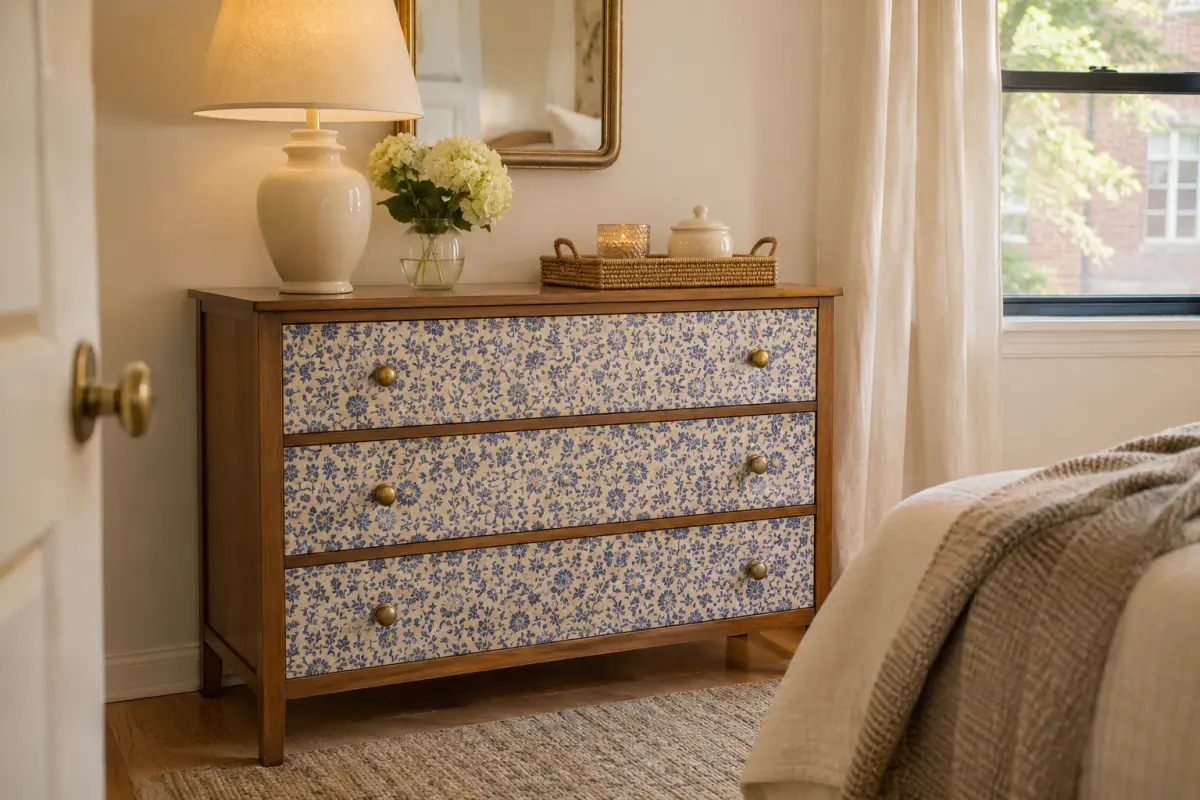
6. Dresser drawer fronts
A plain dresser gets a new face when you cover the drawer fronts. Use one print across all the drawers so the pattern lines up when they are closed.
Take the knobs off first, paper the fronts, then poke through and put the knobs back. Check with your landlord first if the dresser came with the apartment.
Get the look: a smooth-front dresser, a small floral or check print, new knobs in brass or wood.
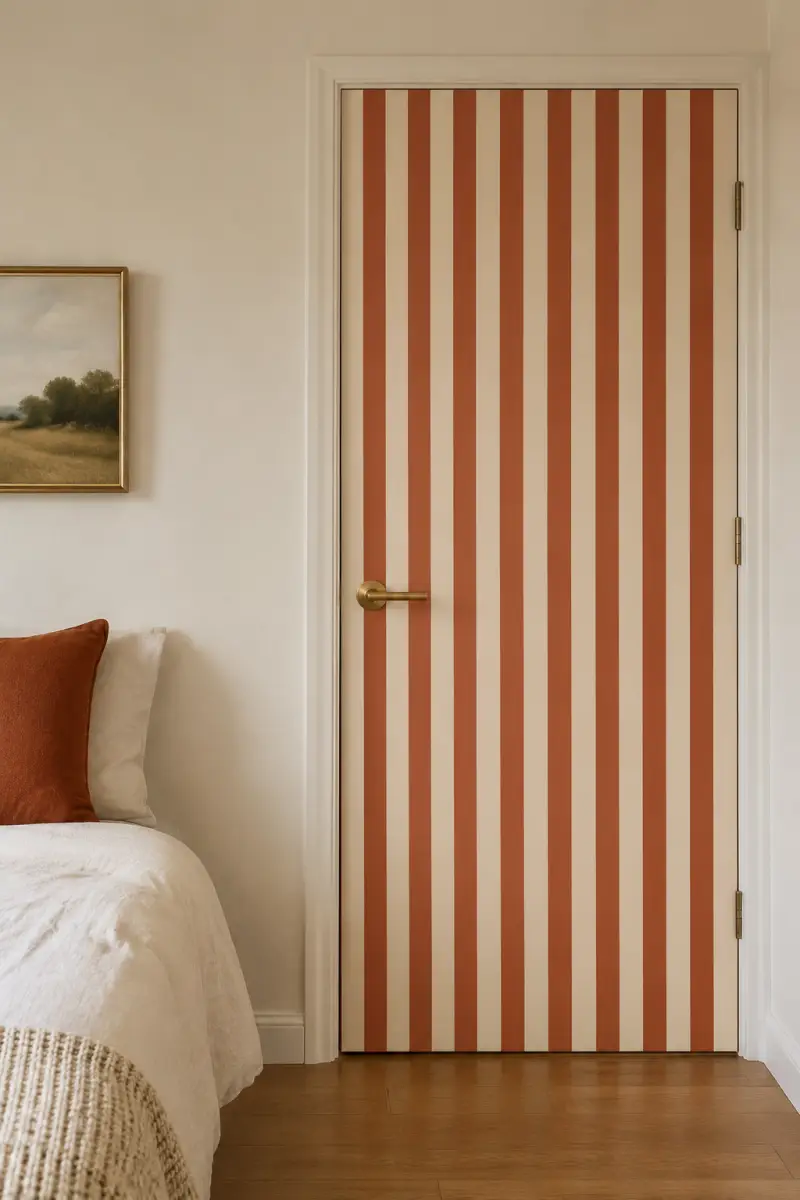
7. A closet or bedroom door
A door is a ready-made frame for pattern, and WallPops lists doors among the surfaces NuWallpaper can cover.
Remove the handle if you can, and trim neatly around the hinges. A papered closet door on a blank wall also works as wall art.
Get the look: a flat (not paneled) door, a vertical print such as stripes or vines, a simple brass handle.
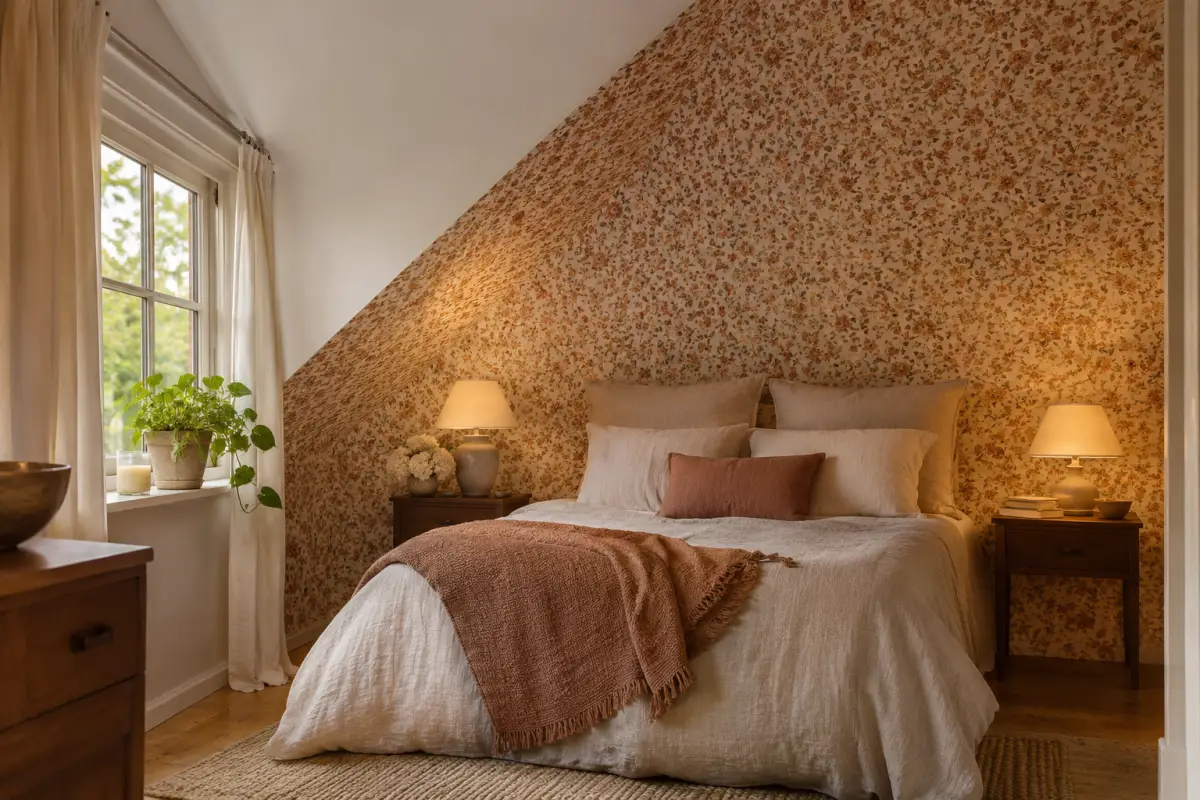
8. A sloped or nook wall
Attic bedrooms and odd alcoves are hard to decorate with furniture, but wallpaper fills them without taking any floor space. Paper the sloped wall or the inside of the nook and leave the rest plain.
Mark a fresh vertical guide line at each corner you turn so the pattern stays straight.
Get the look: a small all-over print that hides angles, warm lamp light, a bed or reading chair tucked into the nook.
Bedroom wallpaper ideas by pattern
These bedroom wallpaper ideas work as an accent wall, a panel or a full room. Order a sample of any pattern first and tape it up next to your bedding for a few days.
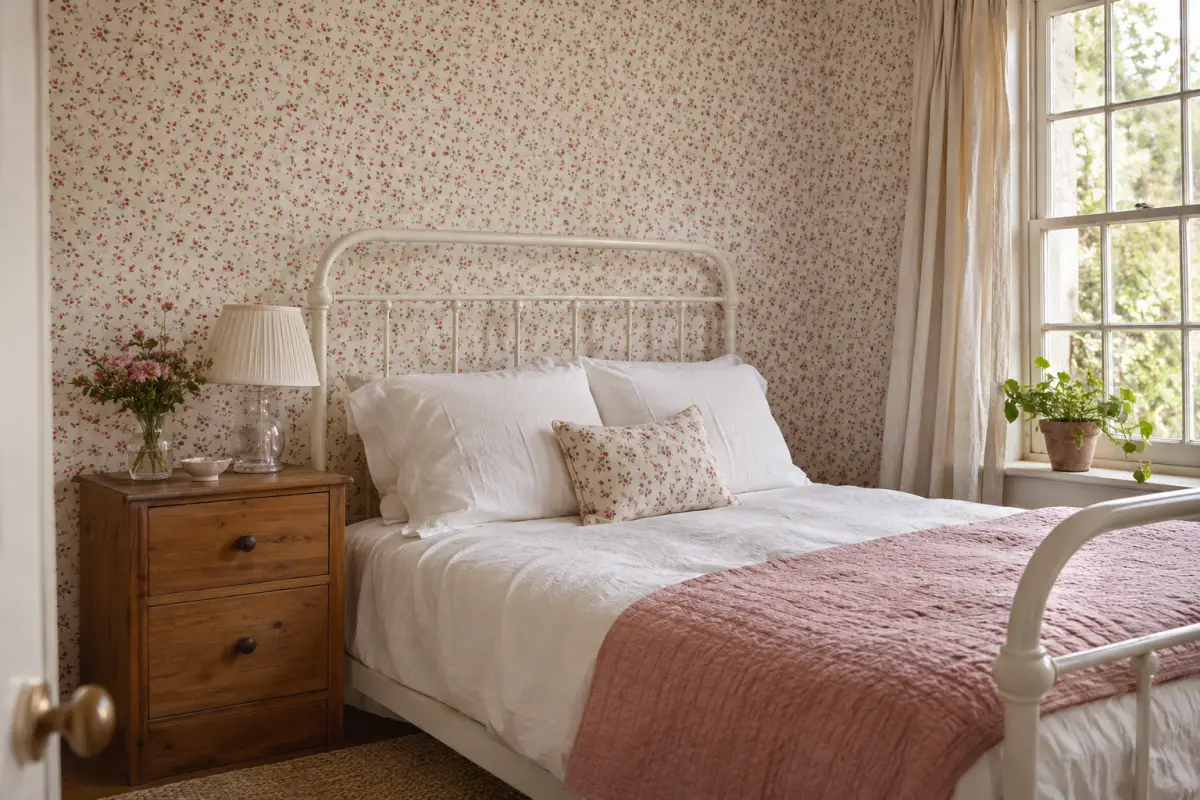
9. Small floral for a cottage bedroom
A small floral is the softest way to add pattern. From the bed it reads almost as a texture, so it suits a room you want to feel calm.
Pull one color from the flowers for the bedding and keep everything else cream or white.
Get the look: ditsy floral paper, white or cream linen bedding, a quilt in one of the print’s colors, a wood bedside table.
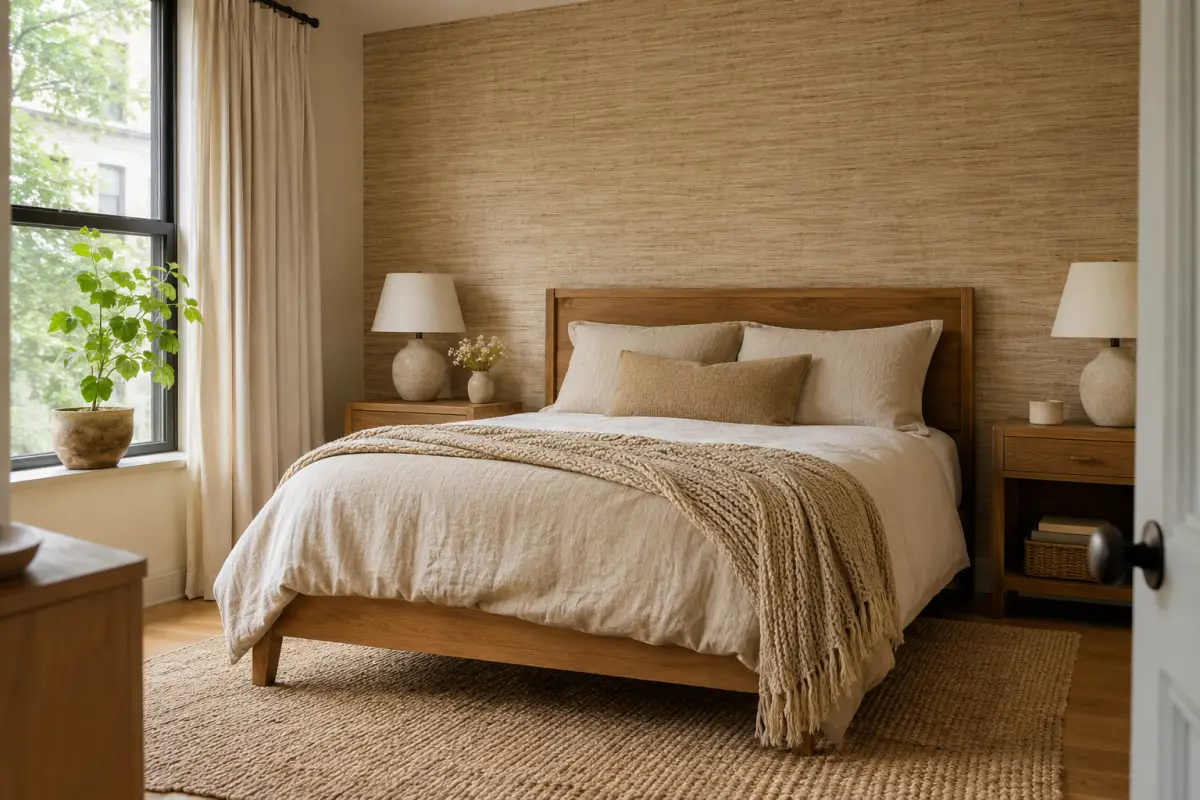
10. Grasscloth look for a calm, neutral room
Peel and stick paper printed to look like woven grasscloth gives a plain wall depth without a pattern you have to match. It is a good pick if bold prints make you nervous.
Beige, stone and soft green versions all sit well with wood furniture and linen bedding.
Get the look: faux grasscloth paper in a warm neutral, oak or walnut bed, linen bedding, a jute rug.
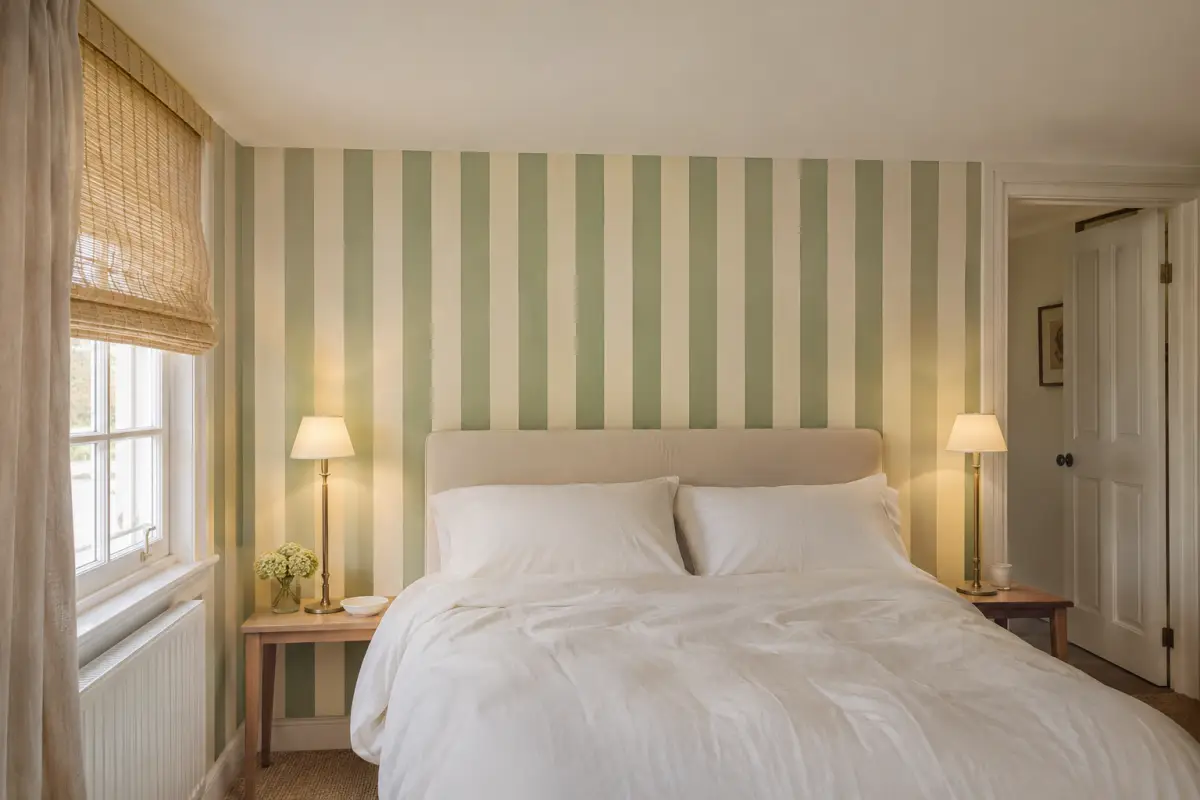
11. Soft stripes to make a wall look taller
Vertical stripes pull the eye up, which helps a bedroom with a low ceiling. Keep the contrast gentle, such as cream with sage or oatmeal with white.
Stripes show every crooked line, so take extra care with your first strip. Chasing Paper’s own guide says a plumb line “is key” for geometric or striped patterns.
Get the look: tonal stripe paper, a level, plain bedding, a slim bedside lamp.
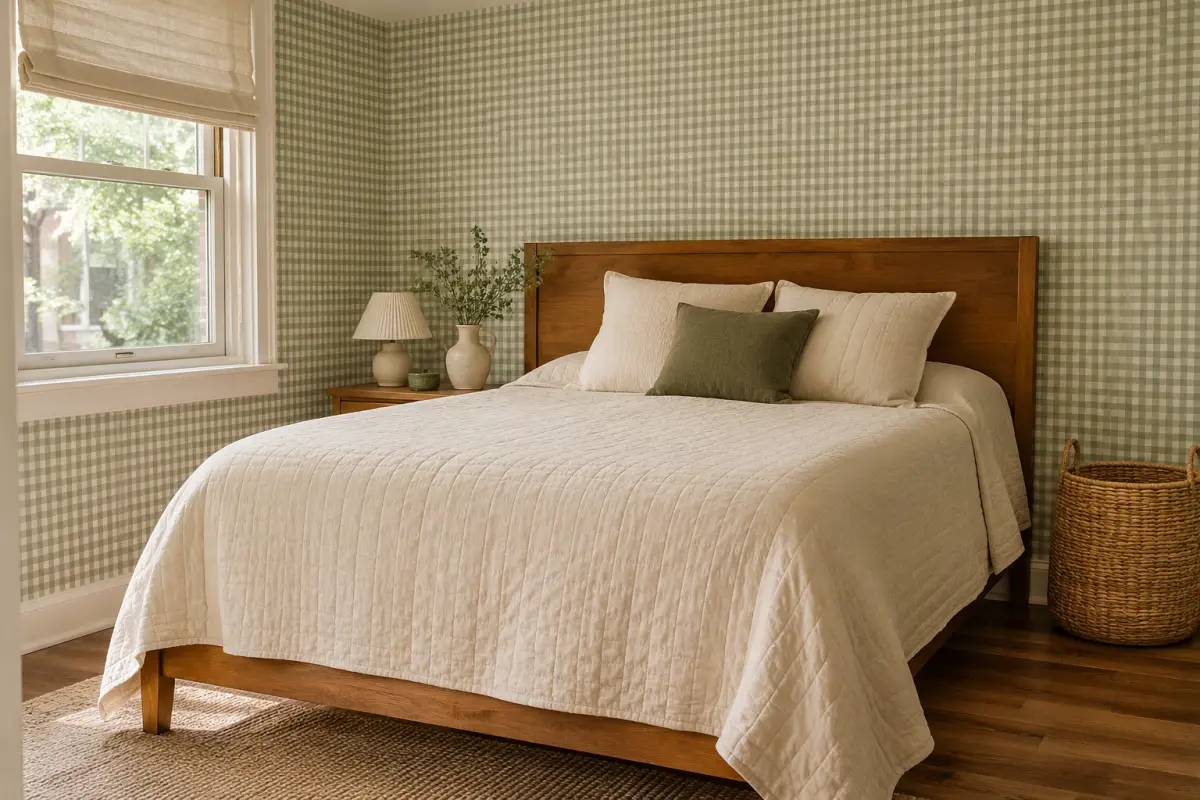
12. Gingham or check for a cozy, casual room
Checks bring a cozy, country feel without flowers. A small check in a muted color looks fresh rather than busy.
Mix it with one solid color and natural wood so the room does not look like a picnic blanket.
Get the look: small check paper in sage, blue or butter yellow, a solid quilt, a wood bed, a woven basket.
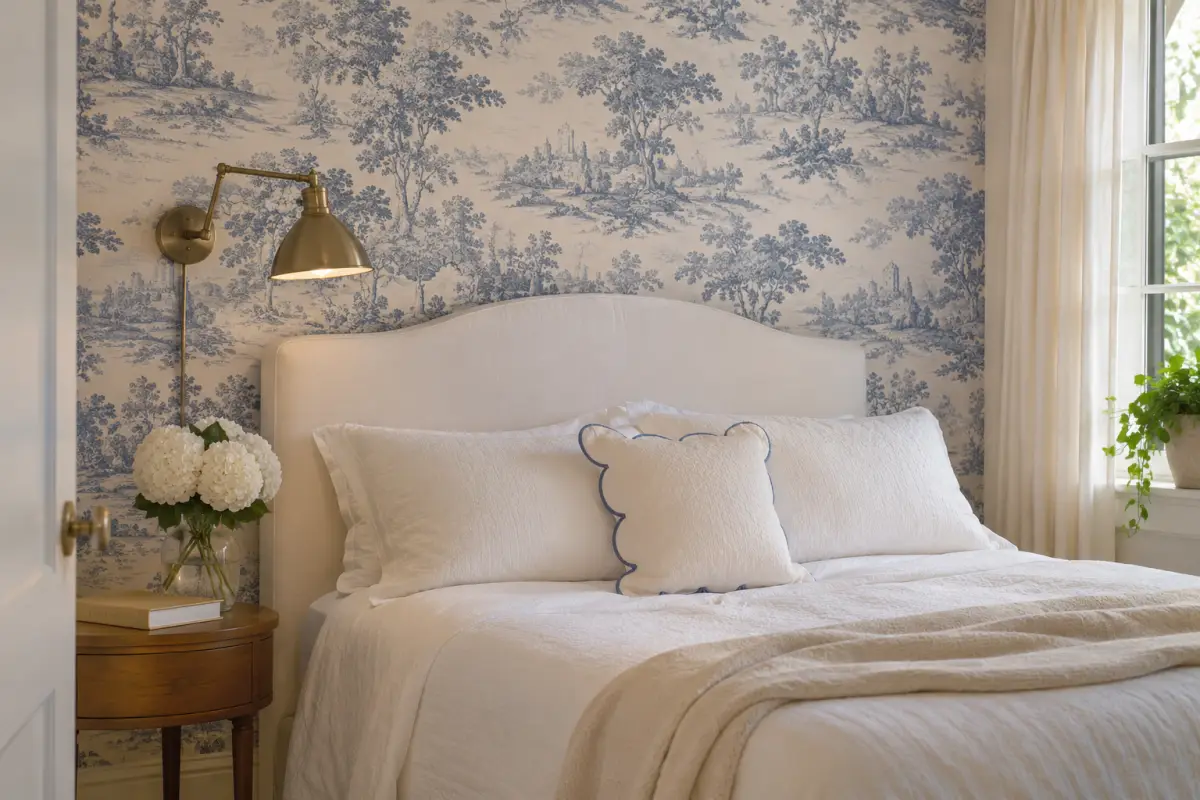
13. Toile for a romantic bedroom
Toile is a one-color scene print, usually trees, figures or landscapes on a pale ground. Because it uses one ink color, it is busy up close but calm from a distance.
Blue and white, sepia and green toiles are easy to pair with white bedding.
Get the look: one-color toile paper, white bedding, a ruffled or scalloped pillow, a brass reading lamp.
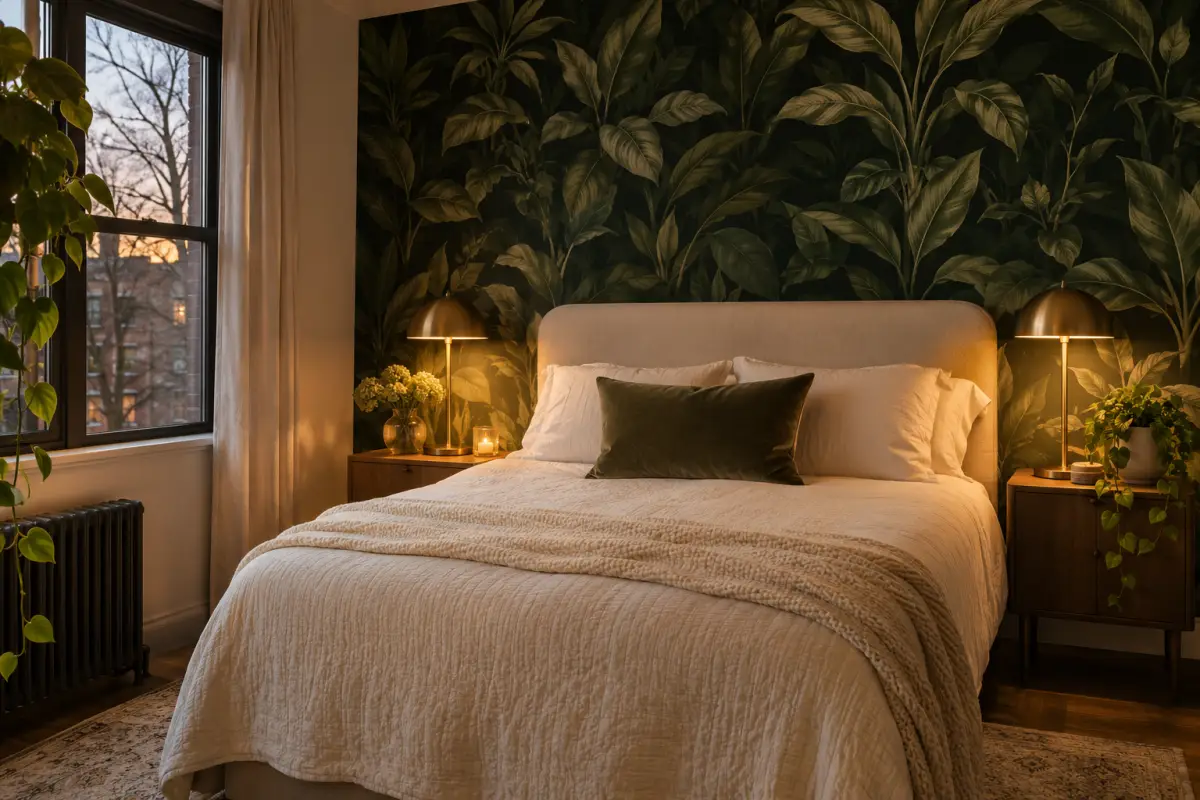
14. Dark botanical for a moody bedroom
A dark leafy print makes a bedroom feel enclosed and restful. It works best on the wall behind the bed with warm lamp light in front of it.
Keep the bedding light so the bed stands out against the dark wall. If you want the same mood with paint, our bedroom painting guide covers dark colors too.
Get the look: deep green or navy botanical paper, cream bedding, brass lamps, a velvet pillow.
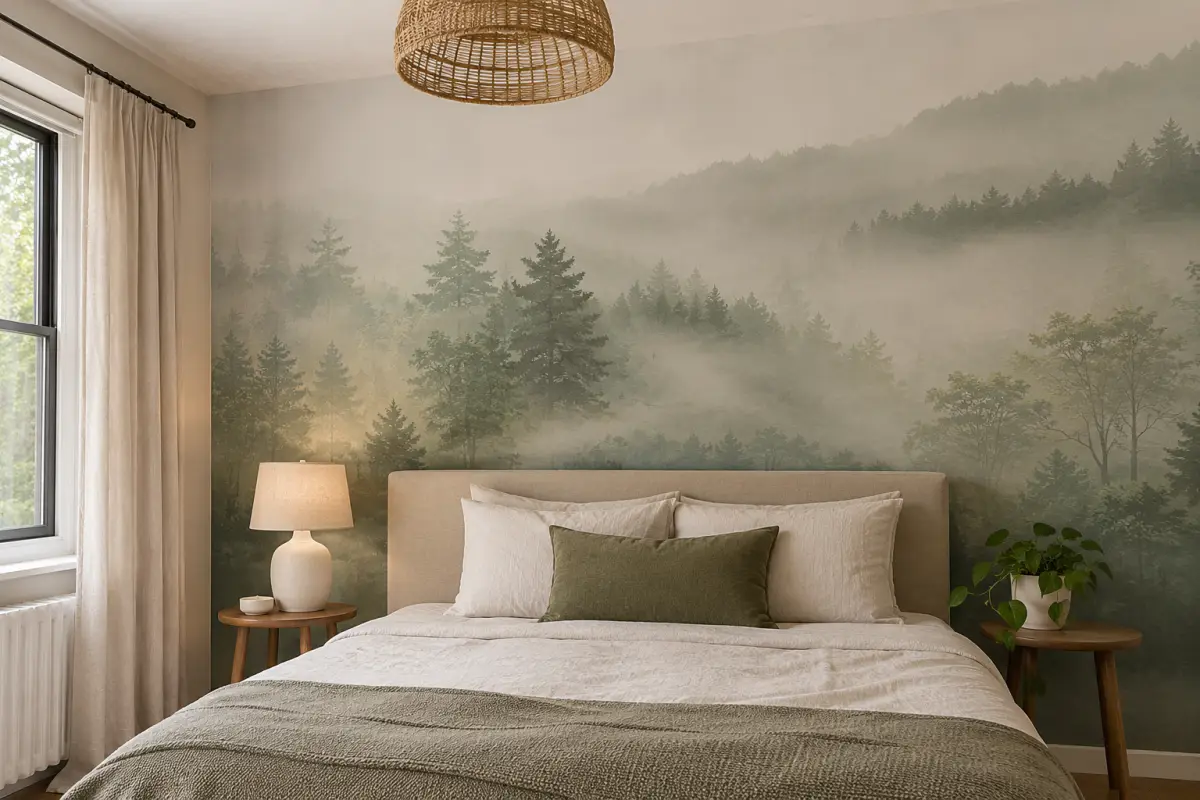
15. A landscape mural
A mural is one large picture split across several panels, such as a misty forest or rolling hills. It works like a giant painting behind the bed.
Lay the panels out on the floor in order before you start, because each one only fits in one place.
Get the look: a soft landscape mural sized to your wall, simple bedding in the mural’s colors, not much else on the wall.
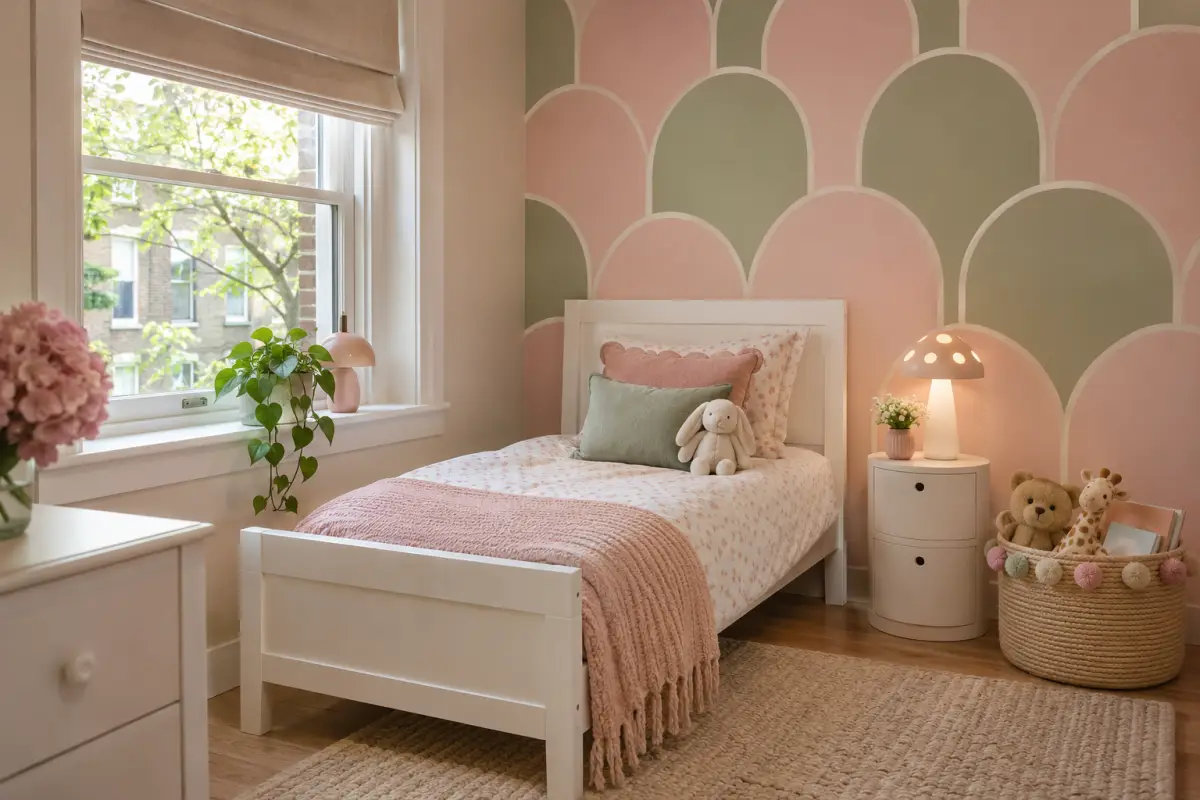
16. Arches or scallops for a kid’s or teen room
Arches, scallops and soft geometric shapes suit a child’s or teen’s room because they feel playful without a cartoon theme. That means the room can grow with them.
Peel and stick is a good match for kids’ rooms because you can change the look later without stripping old paper.
Get the look: arch or scallop print in two soft colors, a white bed, a fun lamp, washable bedding.
17. Plaster or limewash look
Paper printed to look like hand-finished plaster gives you the soft, cloudy wall that is hard to fake with paint. It suits a modern organic bedroom with low furniture and natural materials.
Choose warm stone, clay or sand shades. Cooler greys can look flat.
Get the look: plaster-effect paper, a low wood bed, stone-colored bedding, a paper or rattan pendant.

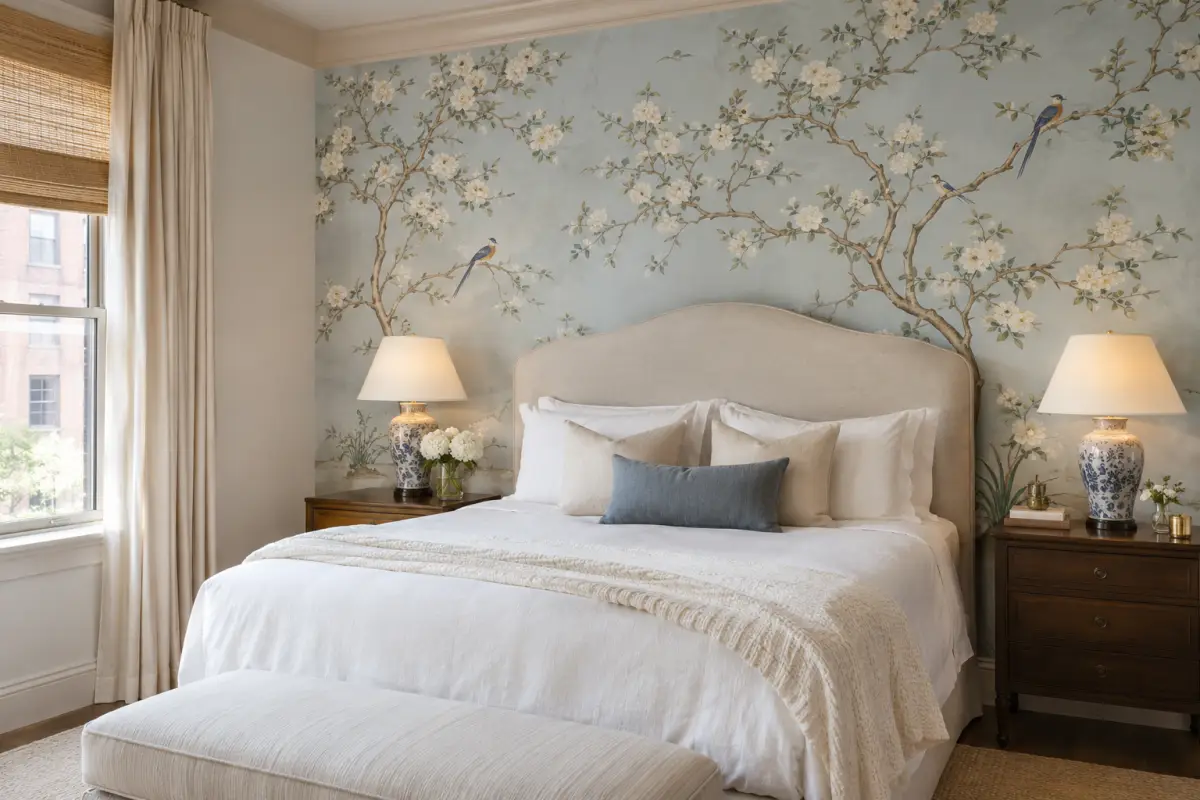
18. A chinoiserie panel set
Chinoiserie panels are hand-painted-style scenes of branches, birds and flowers. One wall of them behind the bed looks like a big piece of art.
Tempaper has a separate step-by-step guide for installing chinoiserie and custom panels, so read the panel instructions for your brand before you start.
Get the look: a chinoiserie panel set, a simple upholstered bed, white bedding, a pair of matching lamps.
Before you buy: which walls peel and stick wallpaper works on
This is where renters win or lose their deposit. The makers below agree on the basics: a smooth, clean, painted wall, with fresh paint left to cure first. Tempaper and Chasing Paper also want paint with some sheen.
Wall finish. Tempaper’s install guide recommends smooth walls “primed and painted with a satin or semi-gloss finish” and lists matte, flat and low sheen paints as not recommended. Its FAQ adds eggshell to the good list and warns that on flat or matte paint, “paint removal could occur when product is removed”.
Texture. Tempaper allows “Nothing more than an orange peel texture”, and Chasing Paper says orange peel, knockdown or bumpy walls won’t give the best results. WallPops does not recommend NuWallpaper on textured walls, old wallpaper, brick or unpainted drywall.
Fresh paint. Wait before you hang it. The makers give different times:
How long to wait after painting
Tempaper
At least 30 days
Chasing Paper
4-6 weeks
NuWallpaper
30 to 60 days
Follow the brand you buy, and check your paint can for its own cure time.
WallPops explains why: the wait lets the paint fully cure, “ensuring that the paper will not damage the paint when it is removed”. If your landlord painted right before you moved in, ask when, and count from that date.
Test first. Tempaper says its paper “may not stick to all surfaces” and asks you to test a small area before a full wall. A sample is the cheapest test; NuWallpaper sells an 8-in x 10-in one. Stick it on the wall you plan to cover, then peel it off slowly and check the paint underneath.
Quick wall check
Good to go
Smooth, clean, painted wall in eggshell, satin or semi-gloss, painted long enough ago to be fully cured.
Test a sample first
Flat or matte paint, a light orange peel texture.
Skip it
Knockdown or heavy texture, old wallpaper, brick, unpainted drywall or plaster, non-stick paint, fresh paint.
How much peel and stick wallpaper you need
Measure the width and height of the area, then use the calculator on the product page of the brand you buy. Roll sizes vary: a Tempaper double roll is either 20.5 inches wide by 11 yards long, covering 56.4 square feet, or 27 inches wide by 9 yards long, covering 60.8 square feet.
A wall 10 feet wide and 8 feet tall is 80 square feet, so it needs more than one of those double rolls before you count any pattern matching. Chasing Paper asks you to order what you need ”+ overage just in case”.
Order everything at once. Colors can vary between print runs, which is why WallPops recommends ordering your whole project together and checking the batch numbers on your rolls. Tempaper ships multiple rolls of one pattern from the same lot number and asks you to request that lot if you reorder.
How to hang peel and stick wallpaper
Every brand’s steps are close, but the details differ, so keep your brand’s instructions open while you work. The order below follows Tempaper’s guide unless noted.
What you need: craft knife, level, pencil, straight edge, step stool, squeegee or smoother, tape measure.
Hanging order at a glance
Clean
Wipe the wall and let it dry.
Mark
Draw a vertical guide line.
Stick
Peel a little backing at a time from the top.
Smooth
Work from the center out.
Trim
Cut the excess with a sharp knife.
Clean the wall. Tempaper recommends a 1:1 mix of isopropyl alcohol and water and says household cleaners can leave a residue. Chasing Paper uses a damp cloth and asks you to let the wall dry fully.
Take off switch plates. Turn the power off first and only turn it back on once the covers are back in place. WallPops suggests papering over the opening, cutting a small “X” and trimming the excess before you screw the plate back on.
Draw a guide line. Measure out from the corner the roll width minus half an inch, so 20 inches for a 20.5-inch roll, and draw a vertical line there with a level.
Peel and stick from the top. Tempaper peels back 3-4 ft. of backing at a time, lines the paper up with the guide and smooths it “from the center out”. Chasing Paper peels about 6 to 8 inches at a time. Leave 2-3 inches of extra paper at the bottom.
Do not stretch it. Pulling on the paper while you hang it can stretch it so the pattern won’t line up. Lift and reposition instead.
Join the next strip. Here the brands differ. Chasing Paper places panels “seam-to-seam” with no overlap, while Tempaper suggests an overlap of 1/8” in a room with temperature swings. Follow your brand.
Trim and fix bubbles. Trim the excess with a sharp knife and a straight edge. For a bubble that will not smooth out, Tempaper suggests a tiny pinhole in its center to let the air out.
How to take peel and stick wallpaper down
Start at any corner and peel slowly, up or down, keeping the paper parallel to the wall rather than pulling it straight out toward you.
If paint lifts anyway, look back at the wall check: the makers warn about flat or matte paint and paint that had not fully cured. For more rental-safe ways to decorate, see our apartment bedroom decor ideas.
Peel and stick wallpaper bedroom FAQ
Is peel and stick wallpaper renter friendly? Usually, on the right wall. WallPops says its peel and stick wallpaper is “completely removable and safe to use in rentals”, but Tempaper warns that paint can come off when the paper is removed from flat or matte paint. Check your lease, test a sample and ask your landlord which paint finish was used.
Does peel and stick wallpaper damage walls? It is designed not to, but fresh or flat paint can lift when you peel it off. Let paint cure for the time your brand gives and peel slowly when you remove it.
Can you hang art on peel and stick wallpaper? Yes. A nail or hook will put a hole in the paper, and for adhesive hooks WallPops suggests cutting a hole in the paper so the hook sticks to the wall itself.
Can you paint over peel and stick wallpaper? No. WallPops says the vinyl repels paint, so peel it off and choose a new pattern instead.
How do you clean it? Wipe it with a damp cloth. Tempaper also suggests keeping its paper away from prolonged heat and direct light sources.
Can it go over old wallpaper? Tempaper says it can go over smooth existing wallpaper but “we cannot guarantee a clean removal”, and WallPops does not recommend it. In a rental, skip it.
Pick one wall and start small
The easiest win is one wall behind the bed or the inside of a closet: a small area costs less, goes up faster and is less to take down when your lease ends. Check the wall, order a sample, then buy every roll at once. For more ideas for the space around your bed, browse our wall decor ideas or read how to decorate bedroom walls next.
Save this pin to your bedroom board so the wall check is there when your rolls arrive.
Sources
- Frequently Asked Questions, Tempaper & Co.
- Peel and Stick FAQs: Install, Removal & Care, WallPops (maker of NuWallpaper)
- Peel & Stick Guide, Chasing Paper
- How to Install Peel and Stick Wallpaper, Tempaper & Co.
- How-To Guide, Chasing Paper