Bedroom Rug Placement: How to Size and Place a Rug, Twin to King
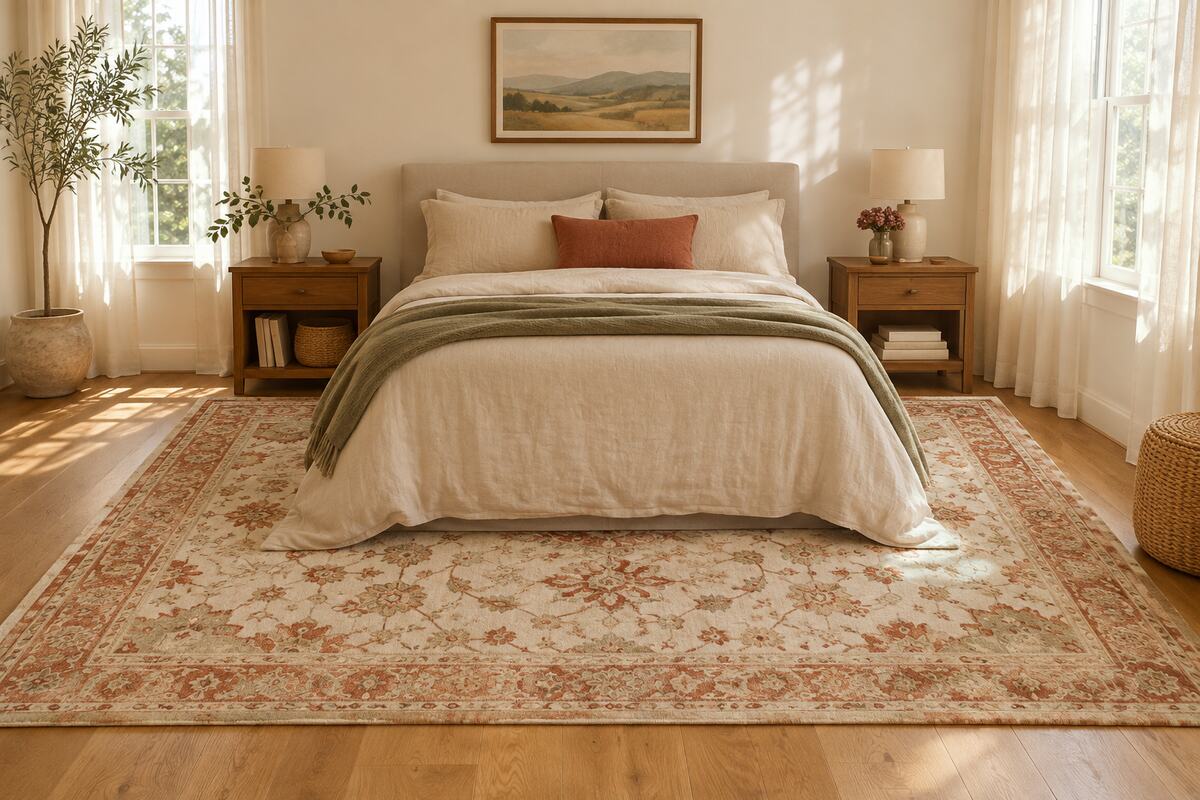
This guide walks you through bedroom rug placement in ten steps: what size rug to buy for a twin, full, queen or king bed, and exactly where it goes. You also get the gaps to leave at walls and doors, when nightstands belong on the rug, and how to keep small rugs from slipping.
Every size here comes from rug makers’ and retailers’ own guides, and where they disagree you get the range, not a guess. Putting a rug over wall-to-wall carpet? That has its own rules, covered in our rug on carpet guide.
What you need:
- A tape measure and a note of your room’s wall lengths
- Your mattress size (twin, full, queen or king) and your bed frame’s width
- A roll of painter’s tape to mark the rug outline on the floor
- A rug pad cut to fit, or double-sided rug tape for small rugs
- A helper to lift the end of the bed if the rug goes underneath
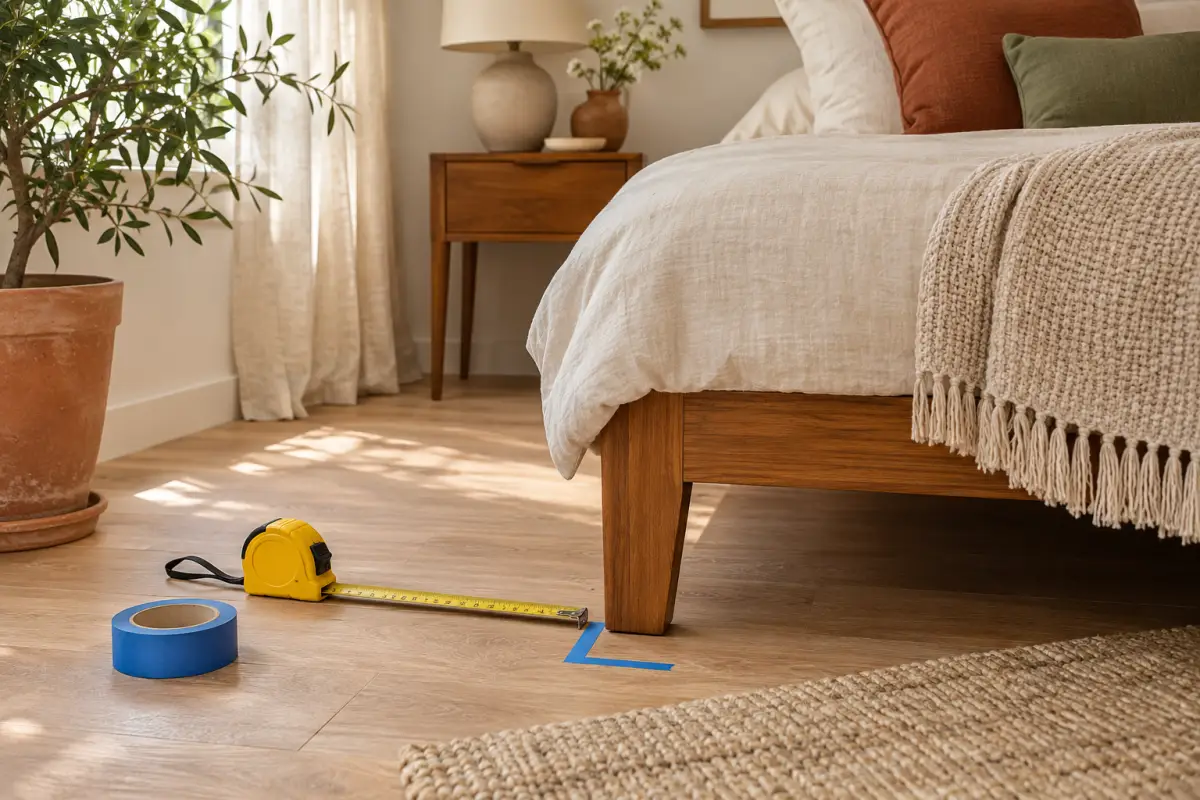
1. Measure your bed and your room
Rug size starts with two numbers: how wide your bed is and how much floor the room has. Casper’s mattress size guide lists a twin at 38 inches wide, a full at 53, a queen at 60 and a king at 76. Measure your frame too, since it is usually a little wider than the mattress.
Then measure the room wall to wall in both directions, and note the door swing, closet and any floor vents. Casper puts the smallest comfortable room for a queen at 10 x 10 feet, with 10 x 12 feet more comfortable. If the bed itself is still undecided, our queen vs king bed comparison helps.
Write both sets of numbers down. You will use them again when you pick a size and when you check the walls.
2. Pick one of four layouts
Ruggable’s bedroom rug guide describes four layouts that cover almost every bedroom. Pick the one that fits your room size, then buy the rug to match it.
- Full under-bed: the rug runs under the whole bed and both nightstands, with rug showing on both sides and at the foot. Best for large primary bedrooms.
- Two-thirds: the rug starts just in front of the nightstands, sits under the lower two-thirds of the bed and runs past the foot. Best for medium rooms.
- Runners on each side: one runner along each side of the bed. Best for narrow rooms where a large rug will not fit.
- One bedside rug: a small rug or sheepskin on the side you get out of bed. Best for guest rooms and studios.
A fifth option suits small rooms: a rug halfway under the bed that stops at the foot, which Ruggable says makes the room look longer.
FOUR BEDROOM RUG LAYOUTS
Seen from above, headboard at the top. Rug in terracotta, bed in cream, nightstands in dark brown.
Full under-bed
Bed and nightstands all on the rug.
Two-thirds
Rug starts just below the nightstands.
Runners each side
For narrow rooms.
One bedside rug
For guest rooms and studios.

3. Choose the rug size for your bed
The rule all three guides share: leave plenty of rug beside the bed so your feet land on it. Ruggable’s golden rule is 18 to 24 inches visible on each side and at the foot, Castlery’s under-bed rug guide sets the same 18 to 24 inches as a minimum, and World Market’s rug size guide says about two feet on all three sides.
Here are the sizes those guides give for each bed. The last column is our own arithmetic: rug length minus mattress width, halved, with the rug’s long side running across the bed.
| Bed | Rug size (feet) | Rug showing each side |
|---|---|---|
| Twin | 5 x 7 or 5 x 8 | About 23 to 29 inches |
| Full | 6 x 9 or 8 x 10 | About 27 to 33 inches |
| Queen | 6 x 9 or 8 x 10 | About 24 to 30 inches |
| King | 8 x 10 or 9 x 12 | About 22 to 34 inches |
For a queen, Ruggable calls an 8 x 10 the most common choice, and Castlery treats a 6 x 9 as a good starting point and an 8 x 10 as the preferred size. For a king, Castlery suggests 8 x 10 as the minimum and 9 x 12 as the sweet spot. Two twin beds side by side can share a 3 x 5 rug between them, or one 8 x 10 under both.
Stuck between two sizes? Castlery’s advice is to size up, because a rug that is too small looks like a postage stamp under the bed.

4. Decide whether the nightstands go on the rug
This is a style choice, and Castlery says both options work as long as you choose on purpose. A rug under the nightstands looks more pulled together; stopping short of them suits smaller rooms and shows off more floor.
Ruggable’s top pick for a queen is an 8 x 10 under the bed and the nightstands. With a smaller rug, World Market suggests a 6 x 9 laid sideways with the nightstands off the rug.
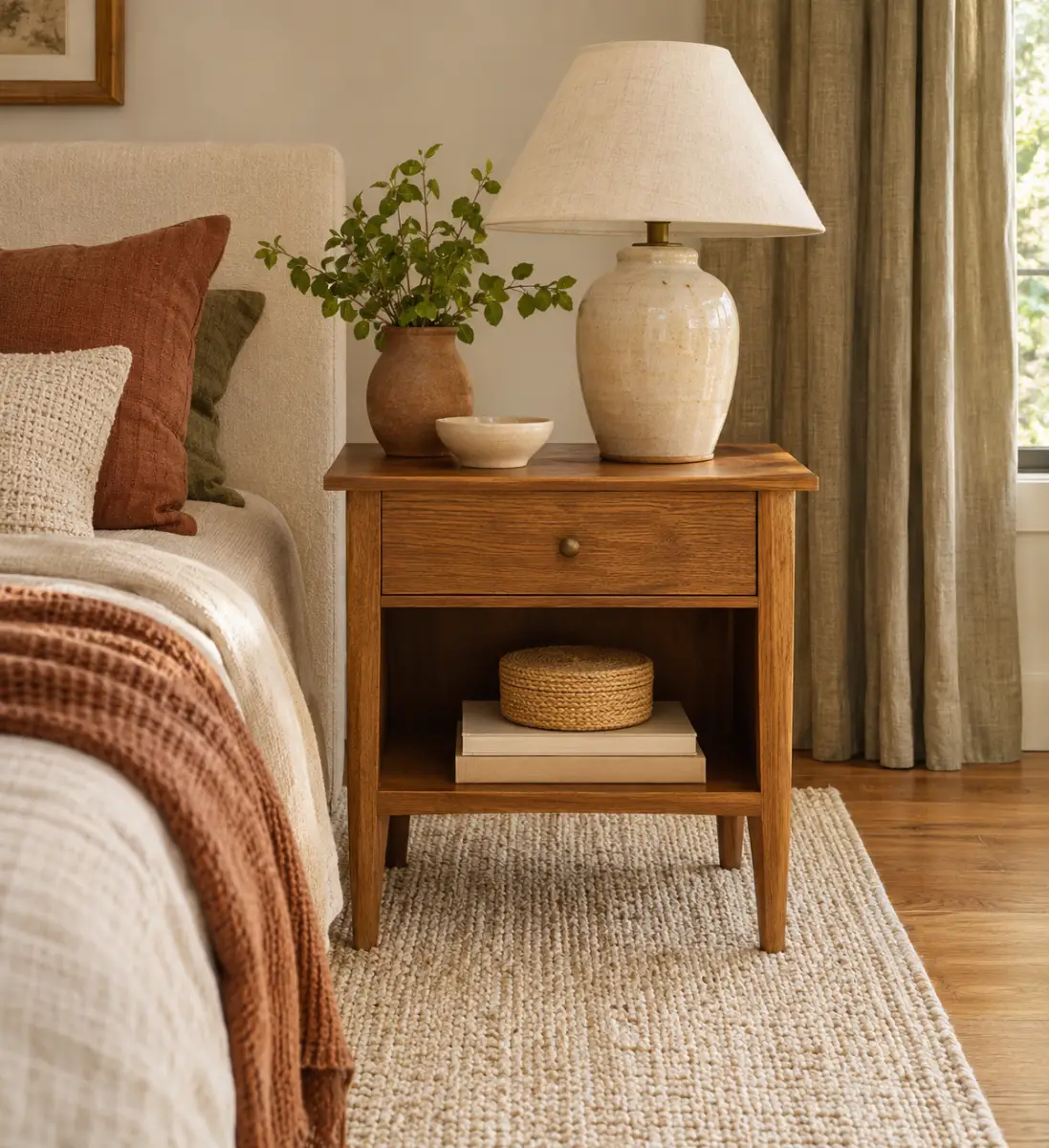
Whichever you pick, keep each nightstand either fully on the rug or fully off it. A table with two legs on the rug and two on the floor sits crooked and wobbles.
5. Turn the rug sideways and center it
Lay a rectangular rug across the bed, not along it. Castlery says a bedroom rug should sit horizontally, perpendicular to the bed’s length, so it reaches out on both sides and past the foot.
Center it left to right: measure from each side of the bed to the rug’s edge and nudge until both numbers match. For the two-thirds layout, line up the top edge of the rug just in front of the nightstands.
If your bed sits in a corner against one wall, the same rug can shift toward the open side, since nobody steps out on the wall side.
6. Leave space at the walls and the door
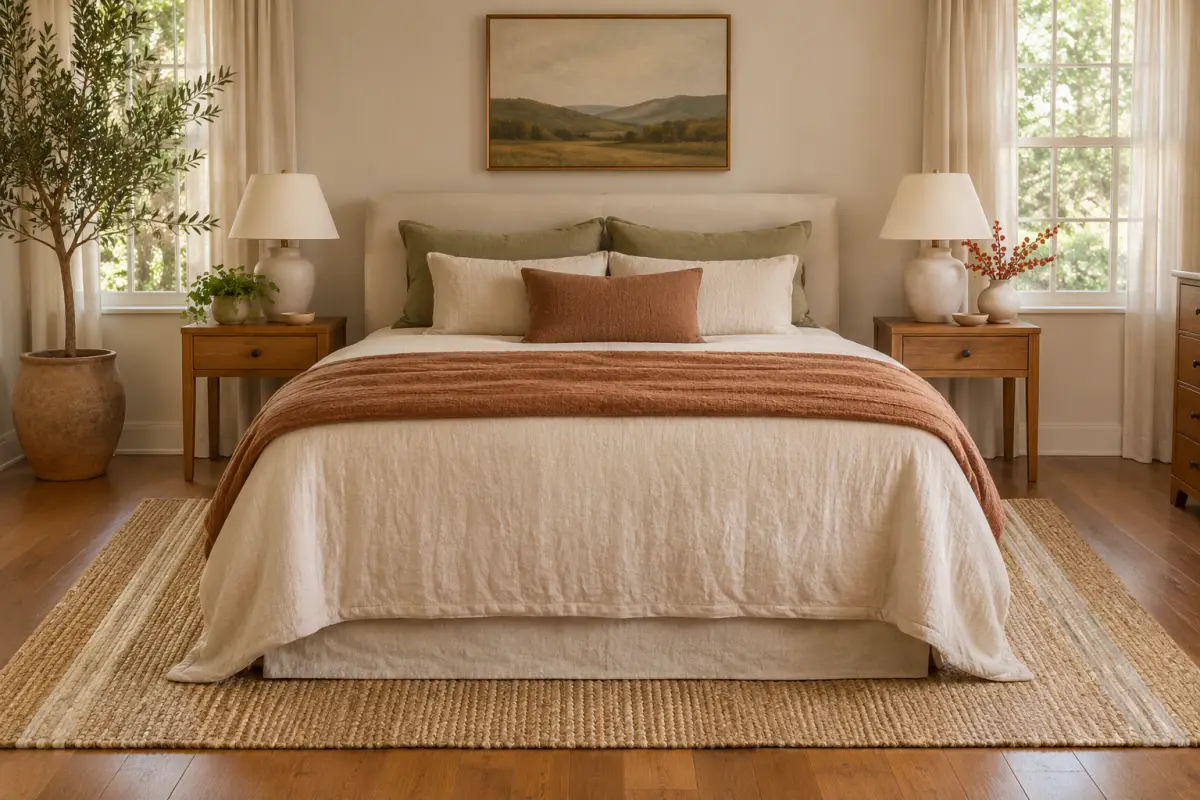
A rug should not run wall to wall. Castlery says to leave 6 to 12 inches between the rug and the walls, and World Market suggests 12 to 24 inches of floor around a bedroom rug.
To find the largest rug your room can take with a 12-inch border, subtract 2 feet from each room dimension. A 10 x 12 foot room fits an 8 x 10 rug with a foot of floor on every side. In a 12 x 12 foot room, the smallest Casper suggests for a king, a 9 x 12 rug would touch two walls, so an 8 x 10 is the better fit. For more on fitting furniture into a tight room, see our small bedroom layout guide.
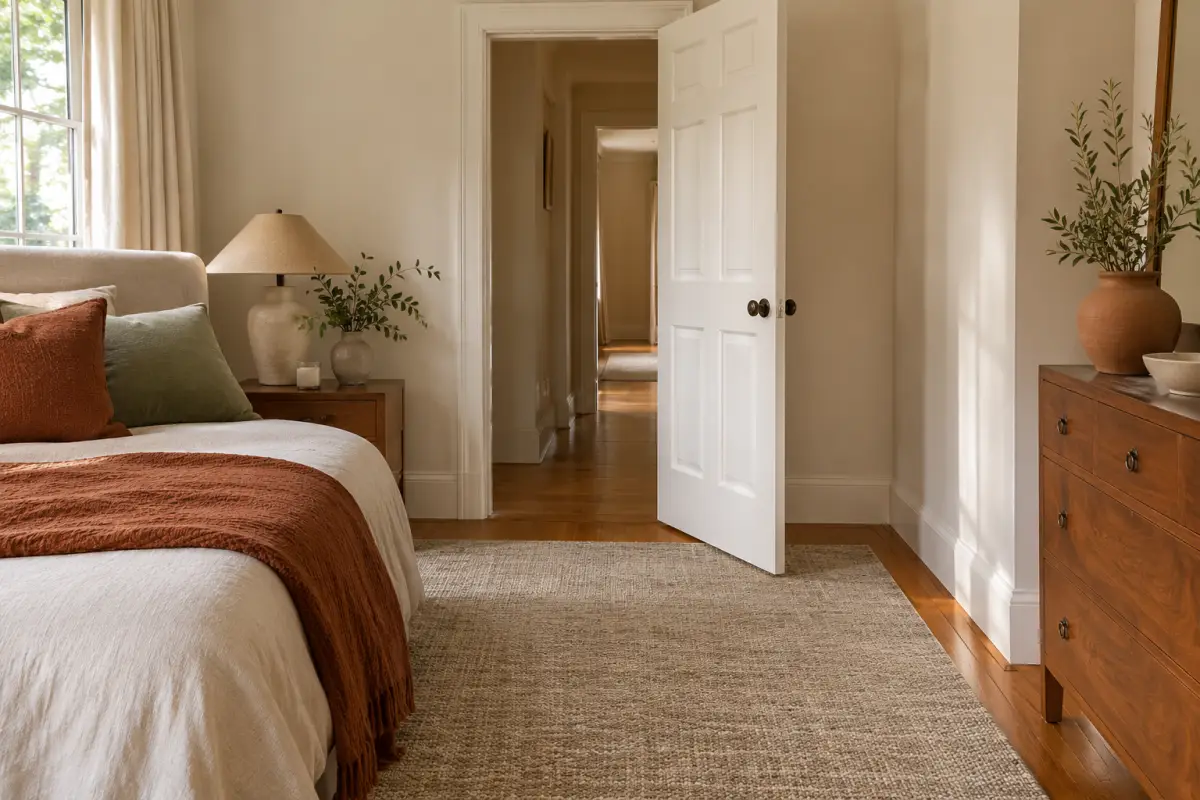
Check the door last. Castlery says to measure the gap between the bottom of the door and the floor, especially with a thick pile rug. Then mark the rug’s outline on the floor with painter’s tape and open the door over it before you buy.
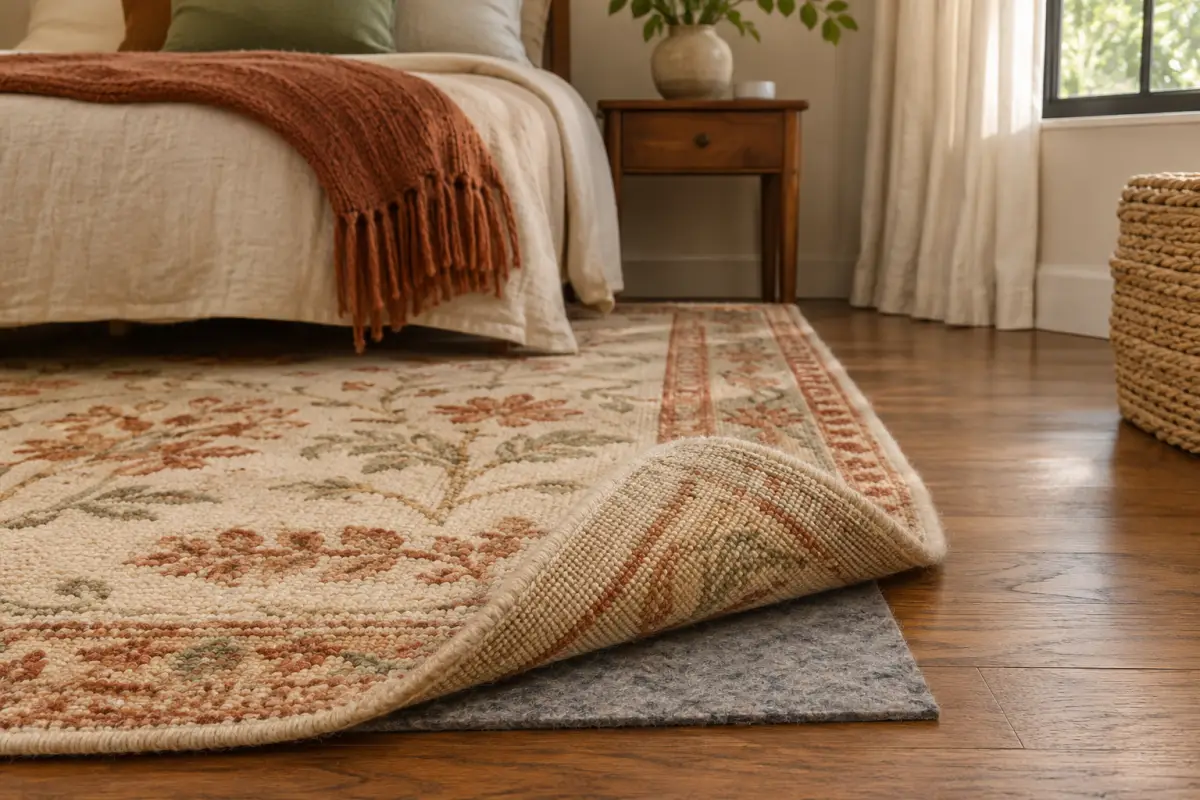
7. Put a rug pad underneath
A pad is what keeps a bedroom rug flat and still. Quince’s rug pad guide says pads stop the rug from sliding, which it calls a safety issue, add cushion and protect the floor. World Market lists skipping the pad as a common rug mistake.
Cut the pad 1 inch smaller than the rug on each side, so a 5 x 7 rug gets a pad of about 4 feet 10 inches by 6 feet 10 inches. The pad should never show past the rug’s edge.
Keep it thin where a door swings over the rug: Quince puts the sweet spot at 1/4 to 3/8 inch. On finished hardwood, avoid PVC or rubber-backed pads, which can react with the floor finish. On carpet, use a thinner pad, and read our rug on carpet guide for the rest.
8. Secure runners and small bedside rugs
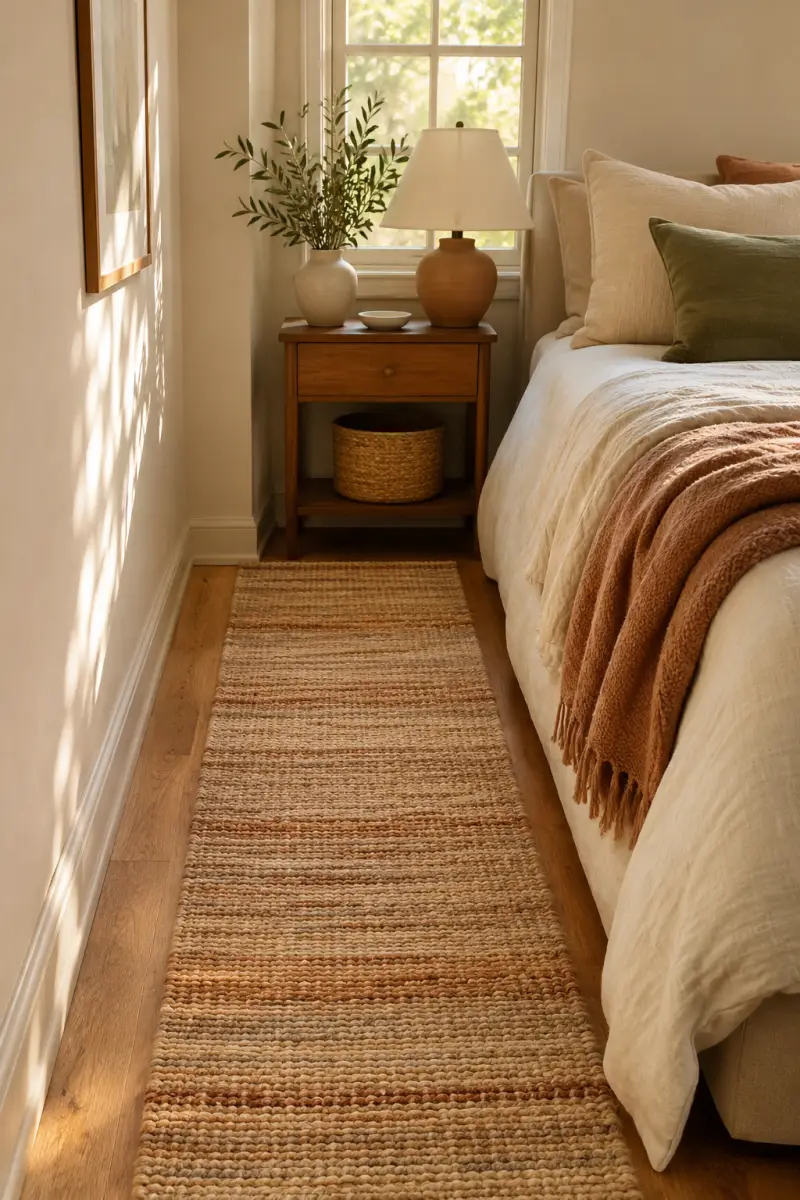
Small rugs are the ones that slip, and beside the bed is where you step out half asleep in the dark. The CDC notes that most falls happen at home and advises removing small throw rugs or using double-sided tape to keep them from slipping, in its fall prevention guide for caregivers.
Give every runner and bedside rug a grip pad or rug tape, unless it has a built-in non-slip backing, which Quince says can go without a pad. This matters most in a room an older relative uses.
For the runner layout, World Market notes most runners are 8 or 12 feet long and usually 3 feet wide or less. With a queen or full bed, two 3 x 5 rugs, one on each side, are another option that needs no bed moving.
9. Lift the bed and lay the rug
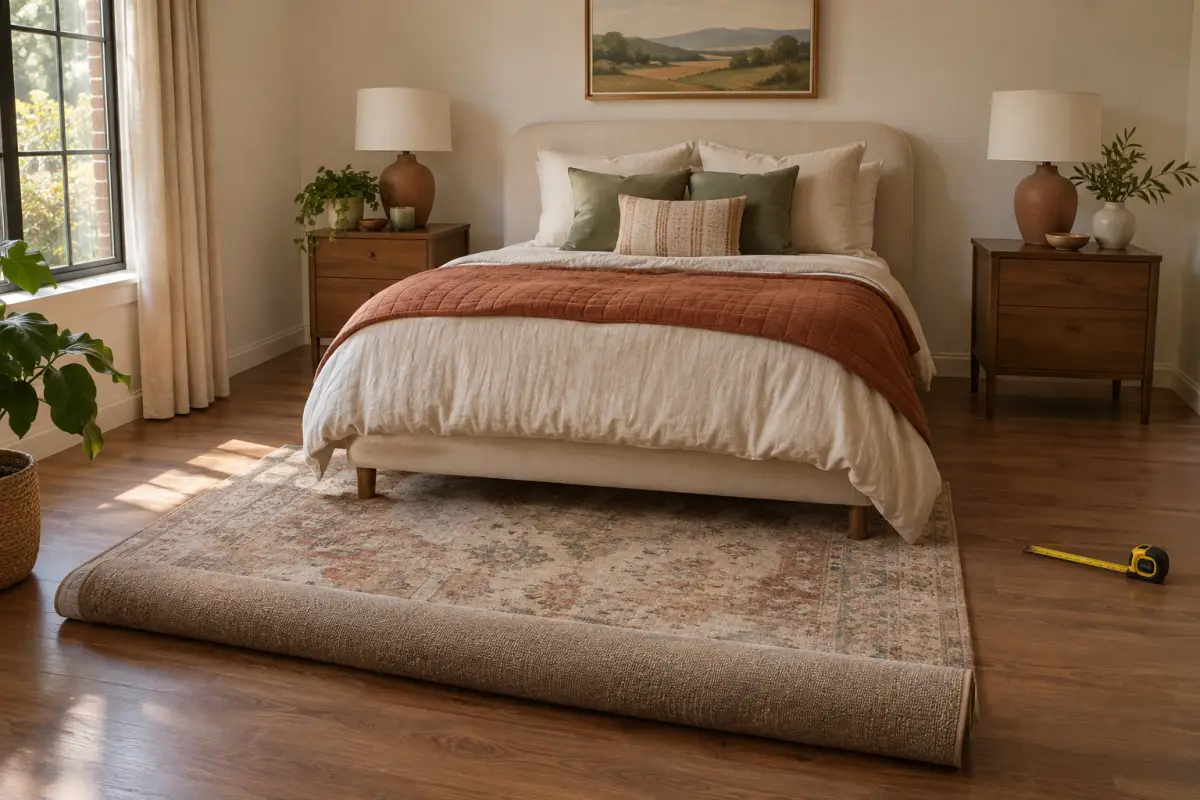
Unroll the rug ahead of time so it can relax flat. Move the nightstands and anything under the bed out of the way first.
With a helper, lift the foot of the bed, slide the rug and pad underneath, and lower the bed onto it. Then measure from each side of the bed to the rug’s edge again, since a rug often shifts as the bed goes down.
Put the nightstands back last, fully on or fully off the rug, as you decided earlier.
10. Layer a second rug if you want more texture
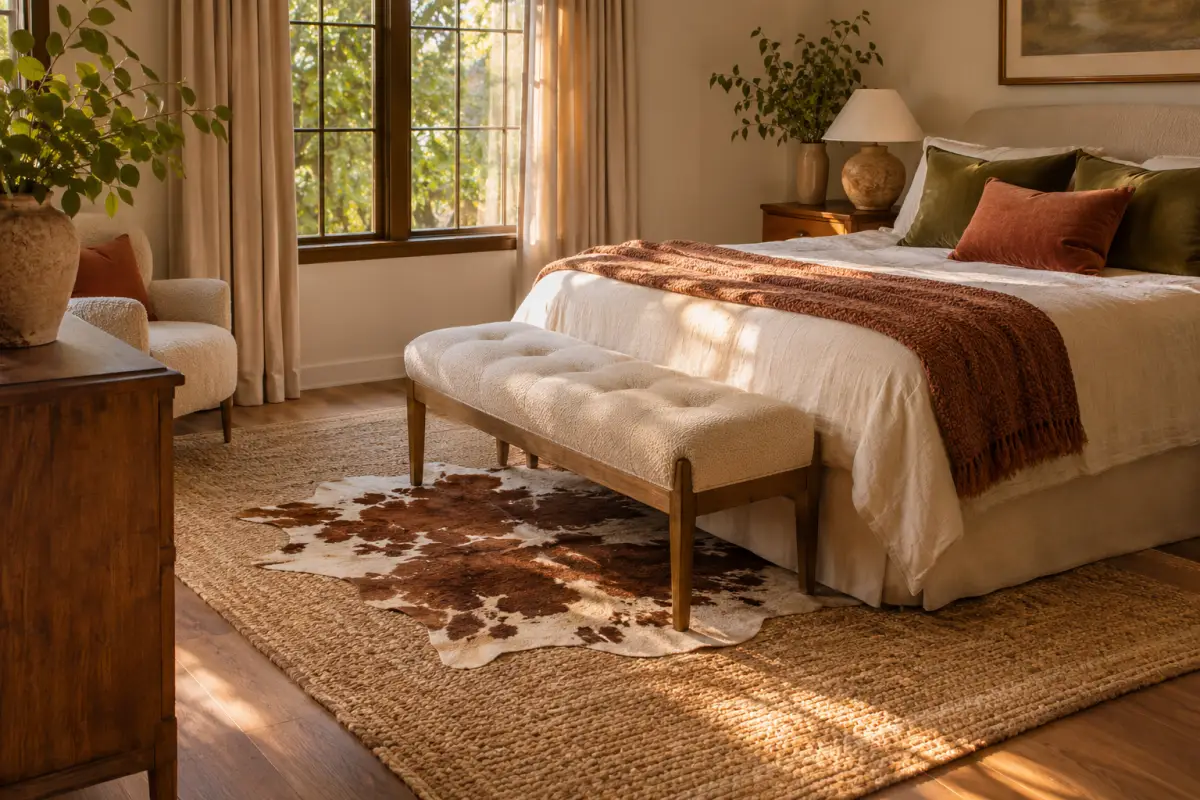
Layering works best in larger bedrooms. Ruggable suggests a larger neutral base rug with a smaller patterned rug on top to add depth or mark out a zone. Castlery and World Market both start with a neutral jute or wool base and lay something smaller, like a flat weave or hide, over it.
Pick colors from your bedding: Ruggable suggests a neutral rug if the bedding is bold or patterned. Our cozy bedroom ideas show more ways to add soft layers around the bed.
Common mistakes to avoid
- Buying too small. A rug that only sits under the foot of the bed without reaching past the sides looks too small and disconnected.
- Pushing the rug against the walls. Leave a border of bare floor around it.
- Half-on nightstands. Keep all four legs on the rug or all four off.
- Skipping the pad. It adds grip and helps the rug last.
- A pad bigger than the rug. It should stay hidden under the edge.
- Forgetting the door. A thick rug can catch on a door that clears bare floor.
Bedroom rug placement FAQ
What size rug goes under a queen bed?
An 8 x 10 is the most common choice for a queen. A 6 x 9 laid sideways also works, with the nightstands and the top of the bed on bare floor.
What size rug do I need for a king bed?
A 9 x 12 works best for a king because it reaches past both nightstands. Castlery treats 8 x 10 as the minimum.
Does a bedroom rug have to go under the whole bed?
No. Ruggable says many bedroom rugs sit under the lower two-thirds of the bed, and full coverage is optional and more common in larger rooms.
Which way should a rug go under a bed?
Sideways, with the long side running across the bed, so it reaches out on both sides and past the foot.
Can a rug be too big for a bedroom?
Yes. Ruggable notes a rug that is too large can overpower the room. If it would touch the walls or block the door, go down a size.
BEDROOM RUG QUICK REFERENCE
- Rug showing beside the bed: 18 to 24 inches
- Floor between rug and walls: 6 to 12 inches
- Queen: 8 x 10 most common
- King: 9 x 12 works best
- Pad: 1 inch smaller than the rug on each side
- Runners and small rugs: grip pad or rug tape
Save this guide to your bedroom board before you shop for a rug, so the sizes are with you in the store. When the rug is down, browse more cozy bedroom ideas and guides for what to layer on top.
Sources
- Mattress Size Chart & Bed Dimensions, Casper
- Bedroom Rug Ideas: Sizes, Placement & Styling Guide, Ruggable, 2026-05-06
- What size rug should I get for under my bed?, Ruggable
- Rug placement under bed: how to place a rug under your bed, Castlery, 2025-06-17
- Find the Perfect Area Rug for Every Room, Cost Plus World Market, 2026-05-12
- Rug Pads (FAQ: All your questions, answered), Quince
- Family Caregivers: Protect Your Loved Ones from Falling, Centers for Disease Control and Prevention (CDC), STEADI, 2023-02-10